RRB NTPC · પ્રશ્ન 16
આપેલા વિધાનો અને તારણો કાળજીપૂર્વક વાંચો. ધારો કે વિધાનોમાં આપેલી માહિતી સાચી છે, ભલે તે સામાન્ય રીતે જાણીતા તથ્યોથી અલગ હોય, તો પણ નક્કી કરો કે આપેલા તારણોમાંથી કયું તારણ(ણો) વિધાનોને તાર્કિક રીતે અનુસરે છે. વિધાનો: કેટલાક ઓશીકા ધાબળા છે. કેટલાક ધાબળા રજાઈ છે. કેટલીક રજાઈ પડદા છે. તારણો: (I) કેટલાક ઓશીકા રજાઈ છે. (II) કેટલાક ધાબળા પડદા છે.
જવાબ બતાવો અને સમજૂતીસમજૂતી જુઓ
જવાબ: (D) ન તો તારણ (I) કે ન તો (II) અનુસરે છે
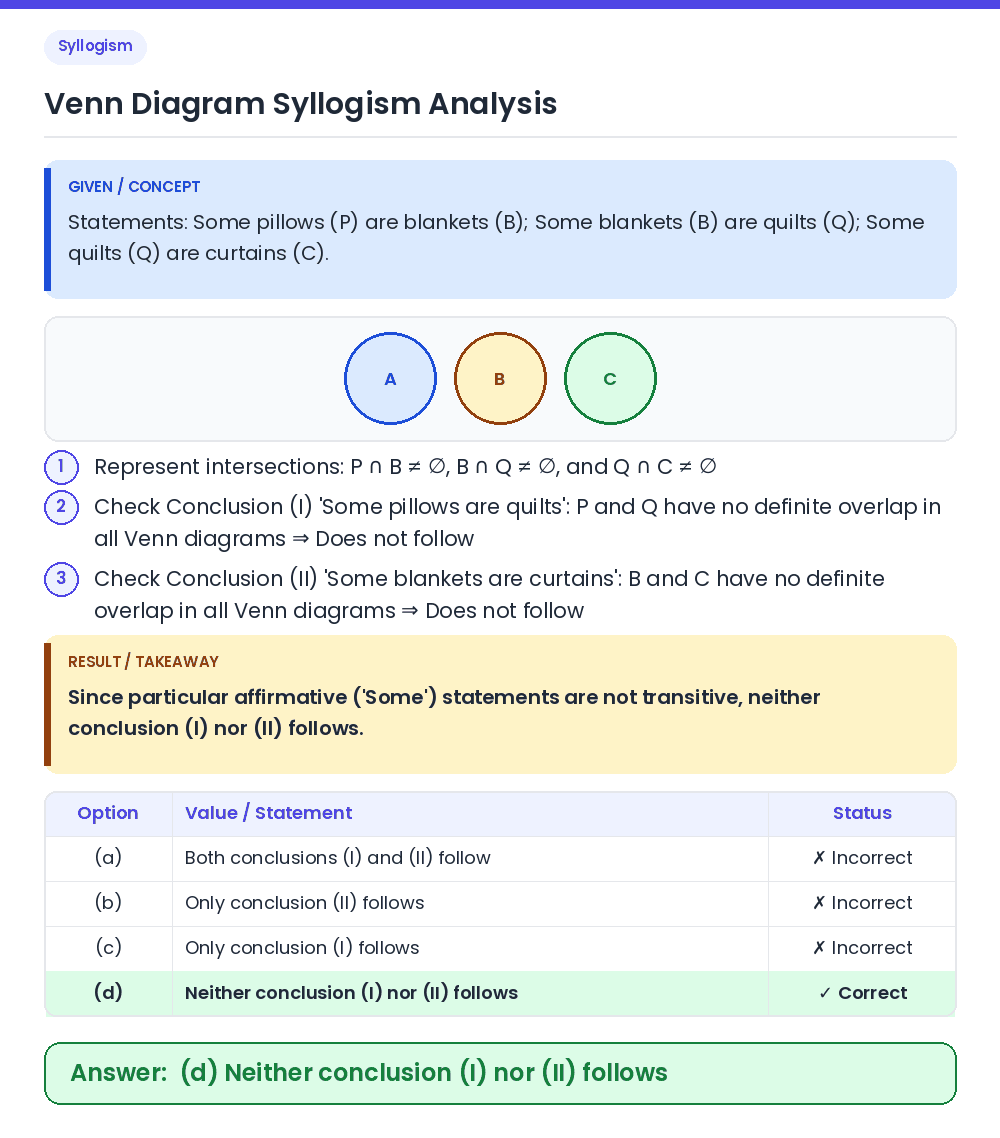
GIVEN / CONCEPT: Statements: Some pillows (P) are blankets (B); Some blankets (B) are quilts (Q); Some quilts (Q) are curtains (C). Represent intersections: P ∩ B ≠ ∅, B ∩ Q ≠ ∅, and Q ∩ C ≠ ∅ Simplification / Calculation: Check Conclusion (I) 'Some pillows are quilts': P and Q have no definite overlap in all Venn diagrams ⇒ Does not follow Verification / Deduction: Check Conclusion (II) 'Some blankets are curtains': B and C have no definite overlap in all Venn diagrams ⇒ Does not follow RESULT / TAKEAWAY: Since particular affirmative ('Some') statements are not transitive, neither conclusion (I) nor (II) follows. Correct Answer: (d) Neither conclusion (I) nor (II) follows