RRB NTPC · ಪ್ರಶ್ನೆ 7
ಸಬ್ಅಟಾಮಿಕ್ ಕಣಗಳ ಆವಿಷ್ಕಾರದಿಂದ ಡಾಲ್ಟನ್ ಪರಮಾಣು ಸಿದ್ಧಾಂತದ ಯಾವ ಪ್ರತಿಪಾದನೆಯು ತಪ್ಪೆಂದು ಸಾಬೀತಾಯಿತು?
ಉತ್ತರ ತೋರಿಸು ಮತ್ತು ವಿವರಣೆವಿವರಣೆ ನೋಡಿ
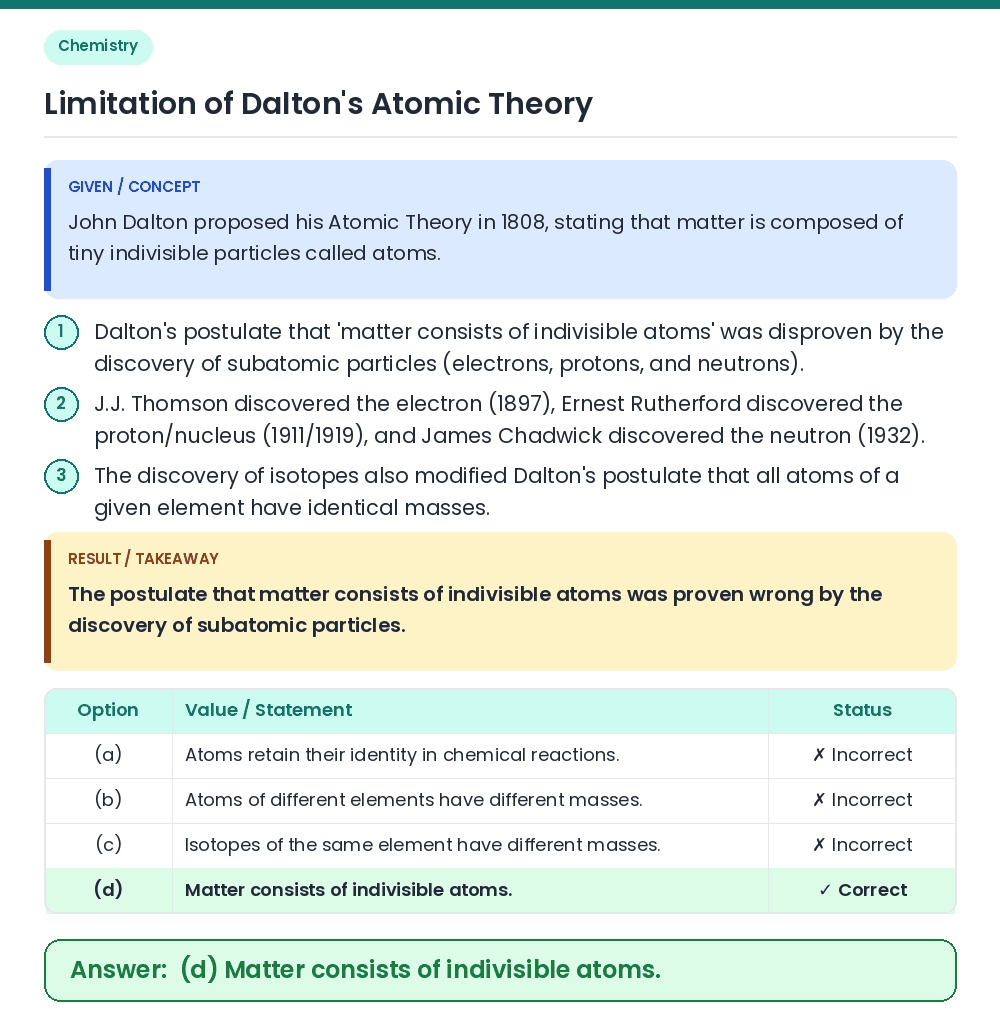
ಉತ್ತರ: (D) ದ್ರವ್ಯವು ಅವಿಭಾಜ್ಯ ಪರಮಾಣುಗಳನ್ನು ಒಳಗೊಂಡಿದೆ.
• John Dalton proposed his Atomic Theory in 1808, stating that matter is composed of tiny indivisible particles called atoms. • The postulate that matter consists of indivisible atoms was proven wrong by the discovery of subatomic particles. Related Facts: • Dalton's postulate that 'matter consists of indivisible atoms' was disproven by the discovery of subatomic particles (electrons, protons, and neutrons). • J.J. Thomson discovered the electron (1897), Ernest Rutherford discovered the proton/nucleus (1911/1919), and James Chadwick discovered the neutron (1932). • The discovery of isotopes also modified Dalton's postulate that all atoms of a given element have identical masses. Correct Answer: (d) Matter consists of indivisible atoms.