RRB NTPC · प्रश्न 78
या प्रश्नामध्ये, एक प्रश्न आणि त्यानंतर (I) आणि (II) असे क्रमांक दिलेली दोन विधाने आहेत. विधानांमध्ये दिलेली माहिती प्रश्नाचे उत्तर देण्यासाठी पुरेशी आहे की नाही हे तुम्हाला ठरवावे लागेल. दोन्ही विधाने वाचा आणि योग्य उत्तर ठरवा. प्रश्न: L, M, N, T आणि V या 5 वृक्षांपैकी प्रत्येक वृक्षाची उंची भिन्न आहे, यापैकी कोणता वृक्ष सर्वात लहान आहे? विधाने: (I) N हे फक्त तीन वृक्षांपेक्षा लहान आहे. (II) N हे M पेक्षा उंच आहे पण T पेक्षा लहान आहे.
उत्तर दाखवा आणि स्पष्टीकरणस्पष्टीकरण पहा
उत्तर: (D) विधाने I आणि II दोन्ही एकत्र (आणि फक्त विधान I किंवा फक्त विधान II नाही) प्रश्नाचे उत्तर देण्यासाठी पुरेशी आहेत
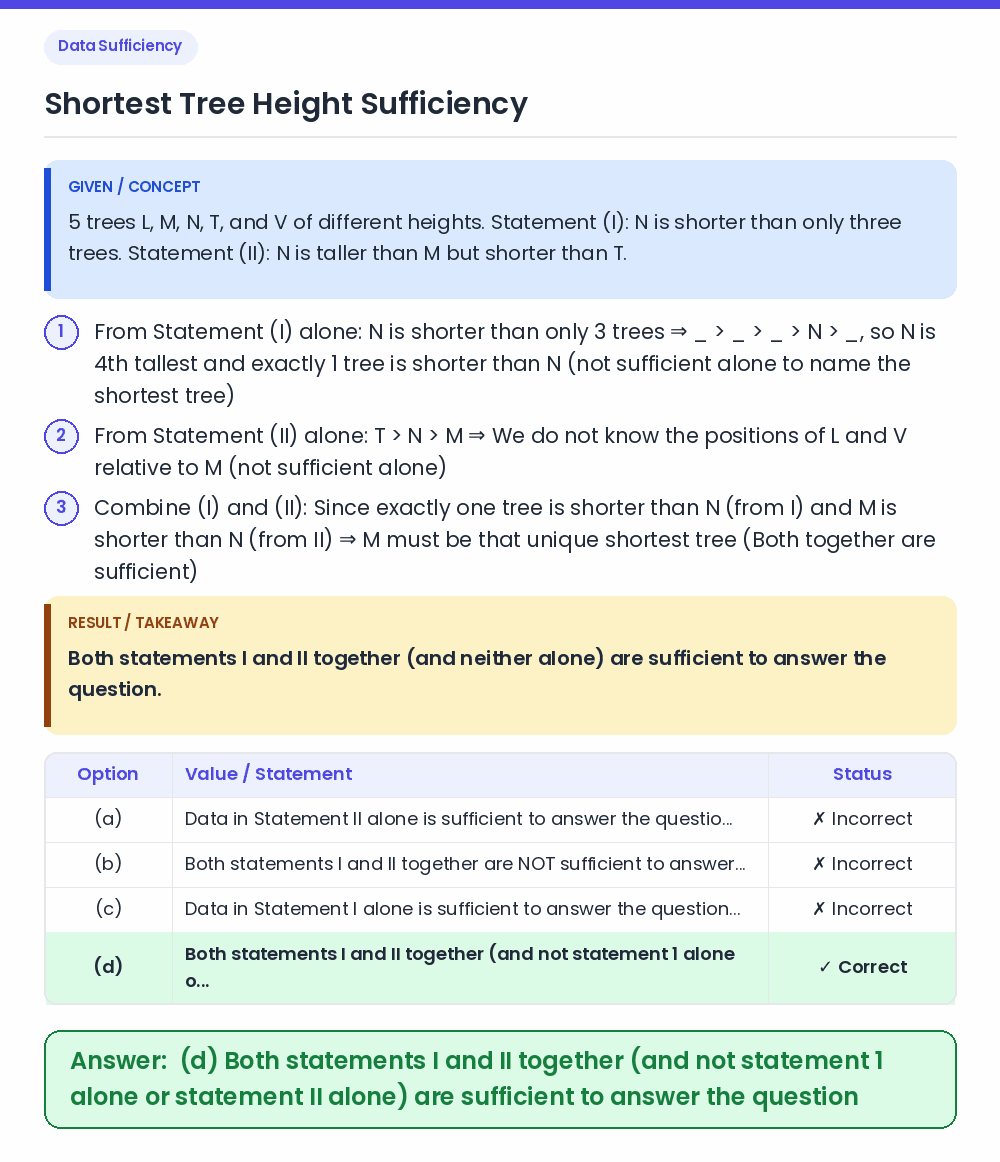
GIVEN / CONCEPT: 5 trees L, M, N, T, and V of different heights. Statement (I): N is shorter than only three trees. Statement (II): N is taller than M but shorter than T. Step 1 (Relation / Equation): From Statement (I) alone: N is shorter than only 3 trees ⇒ _ > _ > _ > N > _, so N is 4th tallest and exactly 1 tree is shorter than N (not sufficient alone to name the shortest tree) Step 2 (Simplification / Calculation): From Statement (II) alone: T > N > M ⇒ We do not know the positions of L and V relative to M (not sufficient alone) Step 3 (Verification / Deduction): Combine (I) and (II): Since exactly one tree is shorter than N (from I) and M is shorter than N (from II) ⇒ M must be that unique shortest tree (Both together are sufficient) RESULT / TAKEAWAY: Both statements I and II together (and neither alone) are sufficient to answer the question. Correct Answer: (d) Both statements I and II together (and not statement 1 alone or statement II alone) are sufficient to answer the question