SSC CHSL – Combined Higher Secondary (10+2) Level Examination · प्रश्न 3
Read the following passage and answer the question based on it: The fundamental and existential threat created by the unprecedented expansion of digital surveillance capabilities poses a serious challenge to the foundational tenets of democracy, revealing a clear contradiction between the demands of modern security and the principles of individual liberty. What was once an abstract concern is now a tangible reality, as these technologies are increasingly compromising civil freedoms. Tools such as facial recognition, bulk data collection, and algorithmic tracking of online activity enable governments and corporations to maintain continuous and highly detailed surveillance over citizens' lives. Such all-encompassing surveillance risks producing a "chilling effect," where individuals, conscious of constant monitoring, begin to censor themselves, limit political participation, and avoid expressing dissenting opinions. In doing so, the very freedom of expression and dissent that sustain a healthy democracy are weakened. Moreover, the potential misuse of these technologies for political repression, social control, and the targeting of marginalised communities signals a troubling slide toward a surveillance state, where the presumption of innocence is replaced by a presumption of suspicion. At its core, the dilemma lies in balancing individual privacy with national security. While governments undeniably require advanced tools to combat terrorism, organised crime, and other serious threats, this necessity must not override the basic right to privacy. Achieving this balance depends on a robust and transparent legal framework that places surveillance practices under strict judicial oversight and ensures public accountability. Technologies such as end-to-end encryption, which are vital for protecting private communication, should be promoted rather than undermined. Additionally, societies must engage in an ongoing and inclusive public dialogue to clearly define what data may be collected, under what circumstances, and for how long. Ultimately, the survival of freedom in the digital age depends on our ability to build a system in which security does not come at the expense of liberty, but one in which technology serves to protect citizens instead of constantly watching them. Question: According to the passage, what is one possible outcome of widespread and all-encompassing surveillance?
उत्तर देखें और व्याख्याव्याख्या देखें
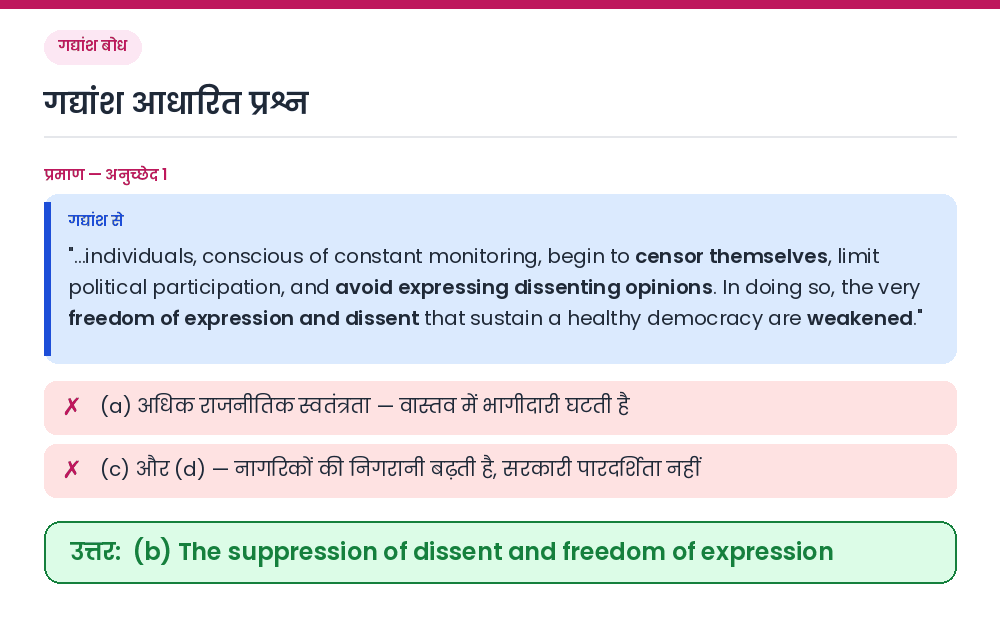
उत्तर: (B) The suppression of dissent and freedom of expression
• अनुच्छेद 1 के अनुसार, सर्वव्यापी निगरानी एक 'चिलिंग इफेक्ट' (भय का प्रभाव) पैदा करती है, जिससे लोग आत्म-सेंसरशिप करने लगते हैं, राजनीतिक भागीदारी घटा देते हैं और असहमति व्यक्त करने से बचते हैं। • इसके परिणामस्वरूप स्वस्थ लोकतंत्र को बनाए रखने वाली अभिव्यक्ति की स्वतंत्रता और असहमति (dissent and freedom of expression) दब जाती हैं। • विकल्प (a), (c) और (d) गद्यांश के विपरीत हैं। सही उत्तर: (b) The suppression of dissent and freedom of expression