Civil Services Examination · प्रश्न 133
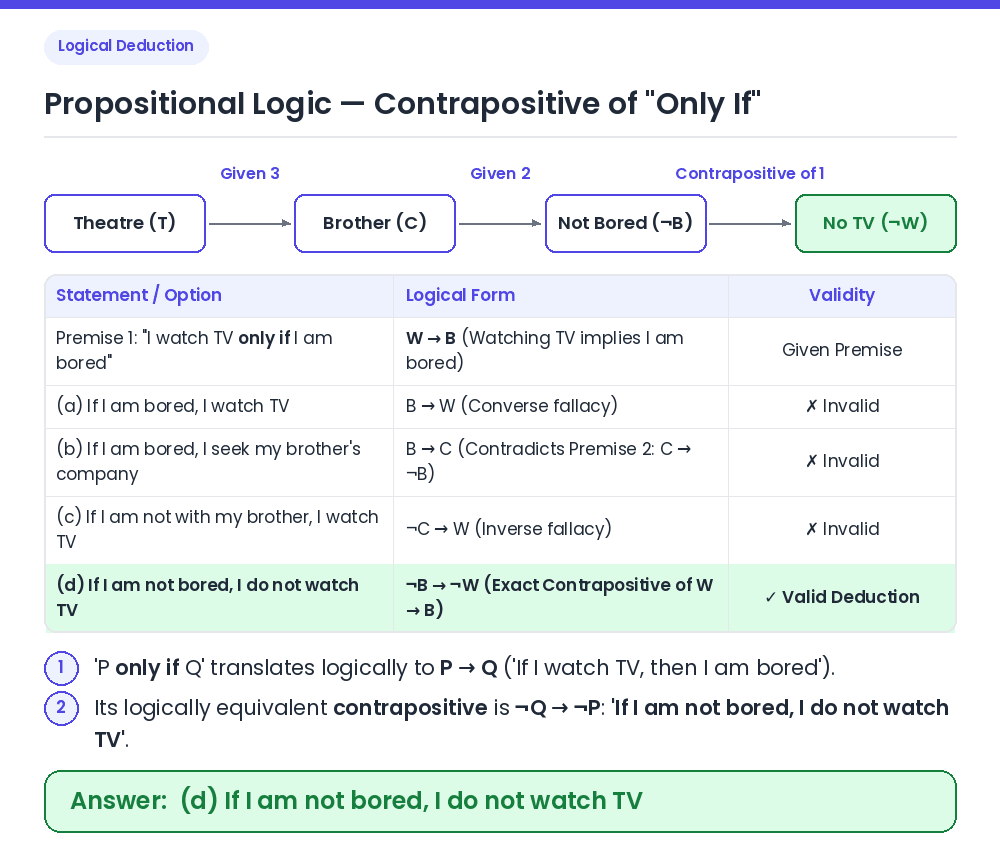
Examine the following statements: I watch TV only if I am bored. I am never bored when I have my brother’s company. Whenever I go to the theatre, I take my brother along. Which one of the following conclusions is valid in the context of the above statements?
उत्तर देखें और व्याख्याव्याख्या देखें
उत्तर: (D) If I am not bored, I do not watch TV
Translate Statements into Logic: Let W = 'I watch TV' and B = 'I am bored'. The statement 'I watch TV only if I am bored' means that being bored is a necessary condition for watching TV: ⇒ W → B (If I watch TV, then I am bored). Apply Contrapositive Rule: A conditional statement (W → B) is always logically equivalent to its contrapositive (¬B → ¬W): ⇒ ¬B → ¬W ('If I am not bored, I do not watch TV'). Why Other Options Fail: Option (a) 'B → W' commits the fallacy of affirming the consequent (you might be bored and still not watch TV); option (c) commits the fallacy of denying the antecedent. Result: Conclusion (d) 'If I am not bored, I do not watch TV' is logically valid. Shortcut: 'A only if B' ≡ 'If not B, then not A'. सही उत्तर: (d) If I am not bored, I do not watch TV