Civil Services Examination · प्रश्न 142
A table has three drawers. It is known that one of the drawers contains two silver coins, another contains two gold coins and the third one contains a silver coin and a gold coin. One of the drawers is opened at random and a coin is drawn. It is found to be a silver coin. What is the probability that the other coin in the drawer is a gold coin?
उत्तर देखें और व्याख्याव्याख्या देखें
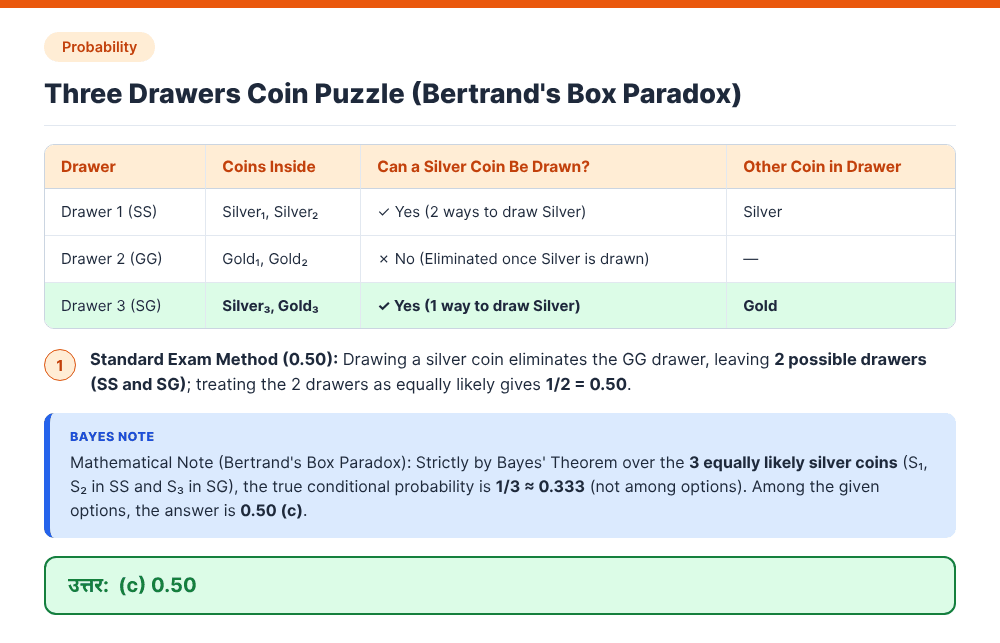
उत्तर: (C) 0.50
Given: The three drawers contain (S, S), (G, G), and (S, G). A coin drawn at random is found to be Silver (S). Standard Exam Approach: Since the drawn coin is silver, the (G, G) drawer is ruled out, leaving only two possible drawers that could have been opened: the (S, S) drawer and the (S, G) drawer. Treating these two drawers as equally likely gives Probability = 1/2 = 0.50. Conditional Probability Note — Bertrand's Box Paradox: Note that rigorously by Bayes' theorem, there are 3 equally likely silver coins that could have been drawn (2 in the SS drawer and 1 in the SG drawer), and in only 1 of those 3 cases is the other coin gold—so the exact conditional probability is 1/3 ≈ 0.333 (which was not provided in the options). Among the given options, (c) 0.50 is the correct answer. Result: Option (c) 0.50 is the official answer. सही उत्तर: (c) 0.50