Civil Services Examination · प्रश्न 45
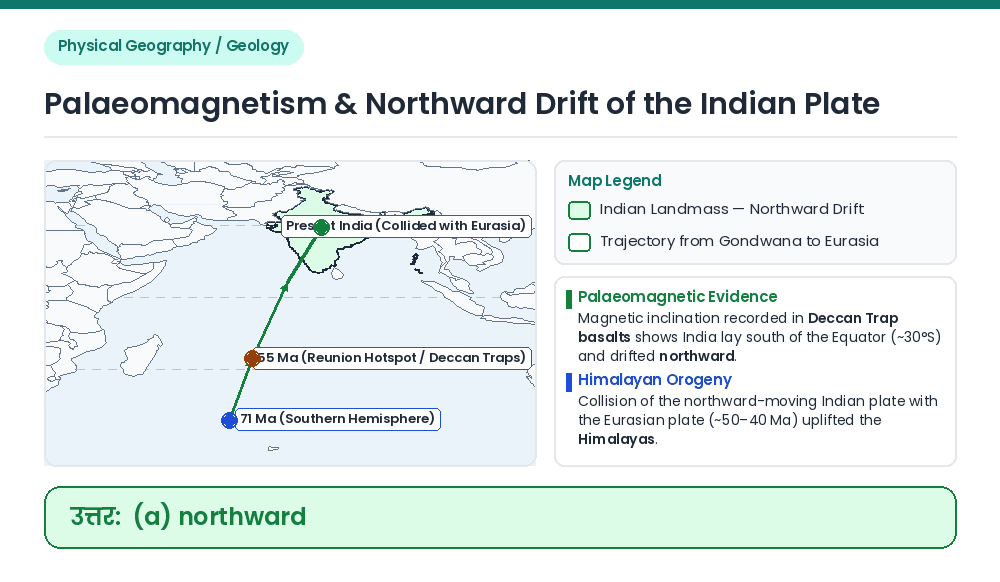
The palaeomagnetic results obtained from India indicate that in the past, the Indian land mass has moved
उत्तर देखें और व्याख्याव्याख्या देखें
उत्तर: (A) northward
Concept: Palaeomagnetism studies the remnant magnetic field preserved in ancient rocks (such as the Deccan Trap basalts) to determine the latitude at which the rocks cooled. Evidence: Palaeomagnetic inclination data from Indian rocks show that the Indian landmass was once located in the Southern Hemisphere as part of Gondwanaland (~30°S–50°S) and progressively drifted northward across the Equator. Tectonic Consequence: This rapid northward drift closed the Tethys Sea and resulted in the collision of the Indian Plate with the Eurasian Plate, uplifting the Himalayas. Result: Palaeomagnetic results indicate that in the past, the Indian landmass has moved northward. Related Facts: • During its northward journey over the Réunion hotspot (~66 million years ago), massive flood basalt eruptions formed the Deccan Traps. सही उत्तर: (a) northward