Civil Services Examination · प्रश्न 76
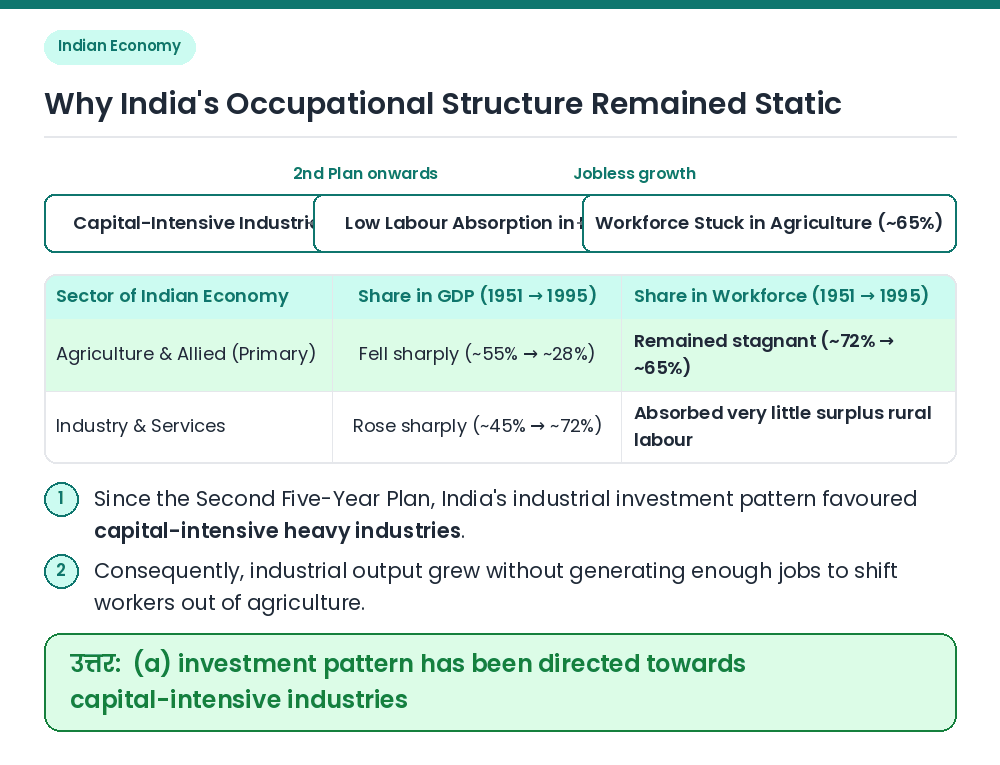
One of the reasons for India’s occupational structure remaining more or less the same over the years has been that
उत्तर देखें और व्याख्याव्याख्या देखें
उत्तर: (A) investment pattern has been directed towards capital-intensive industries
Concept: Occupational structure refers to the distribution of the working population across the primary (agriculture), secondary (industry), and tertiary (services) sectors. Economic Cause: From the Second Five-Year Plan (Mahalanobis strategy) onwards, India's industrial investment was heavily directed towards capital-intensive basic and heavy industries rather than labour-intensive manufacturing. Impact on Labour Transfer: While the share of industry and services in GDP rose substantially, capital-intensive industrialisation failed to absorb the disguisedly unemployed workforce from agriculture, leaving ~65% of workers dependent on agriculture. Result: The investment pattern directed towards capital-intensive industries kept India's occupational structure largely unchanged. Related Facts: • In classical structural transformation (Clark-Kuznets-Lewis model), both GDP share and workforce share shift from agriculture to industry and services. सही उत्तर: (a) investment pattern has been directed towards capital-intensive industries