Civil Services Examination · प्रश्न 82
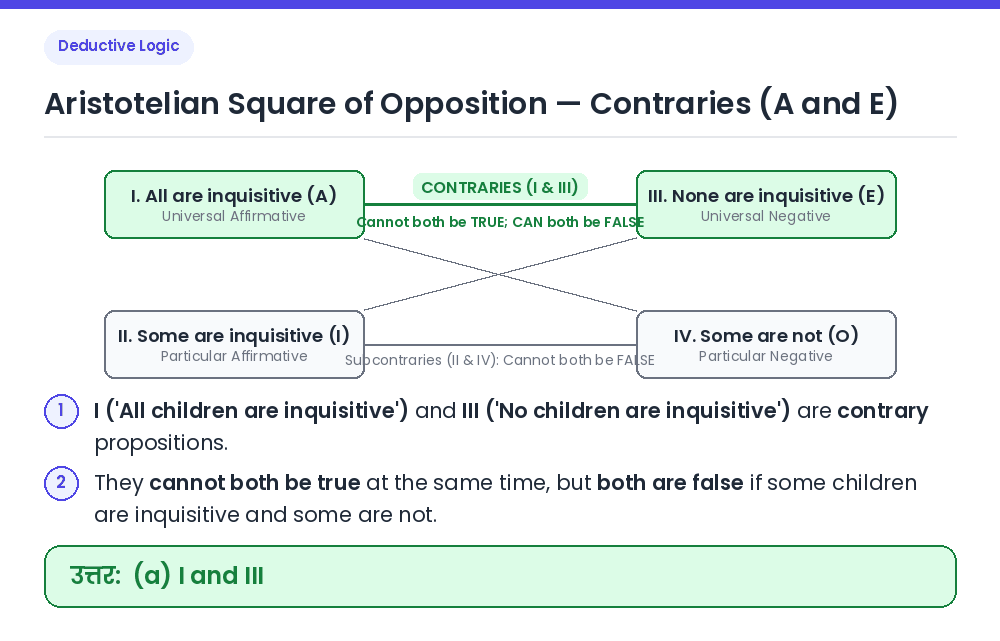
Examine the following statements: I. All children are inquisitive. II. Some children are inquisitive. III. No children are inquisitive. IV. Some children are not inquisitive. Among these statements, the two statements which cannot both be true simultaneously but can both be false would be
उत्तर देखें और व्याख्याव्याख्या देखें
उत्तर: (A) I and III
Classify Propositions: In classical categorical logic, I is Universal Affirmative (A: 'All S are P'), II is Particular Affirmative (I: 'Some S are P'), III is Universal Negative (E: 'No S are P'), and IV is Particular Negative (O: 'Some S are not P'). Identify Contraries: Universal Affirmative (I) and Universal Negative (III) are 'contraries'—they cannot both be true simultaneously, because if all children are inquisitive, it cannot be that no children are inquisitive. Verify Both False: However, both I and III can be false at the same time whenever some children are inquisitive and some children are not inquisitive. Result: The two statements are I and III. Shortcut: Remember the Square of Opposition rule — Top pair (All vs No = I and III) are Contraries (cannot both be true, can both be false). सही उत्तर: (a) I and III