Civil Services Examination · प्रश्न 121
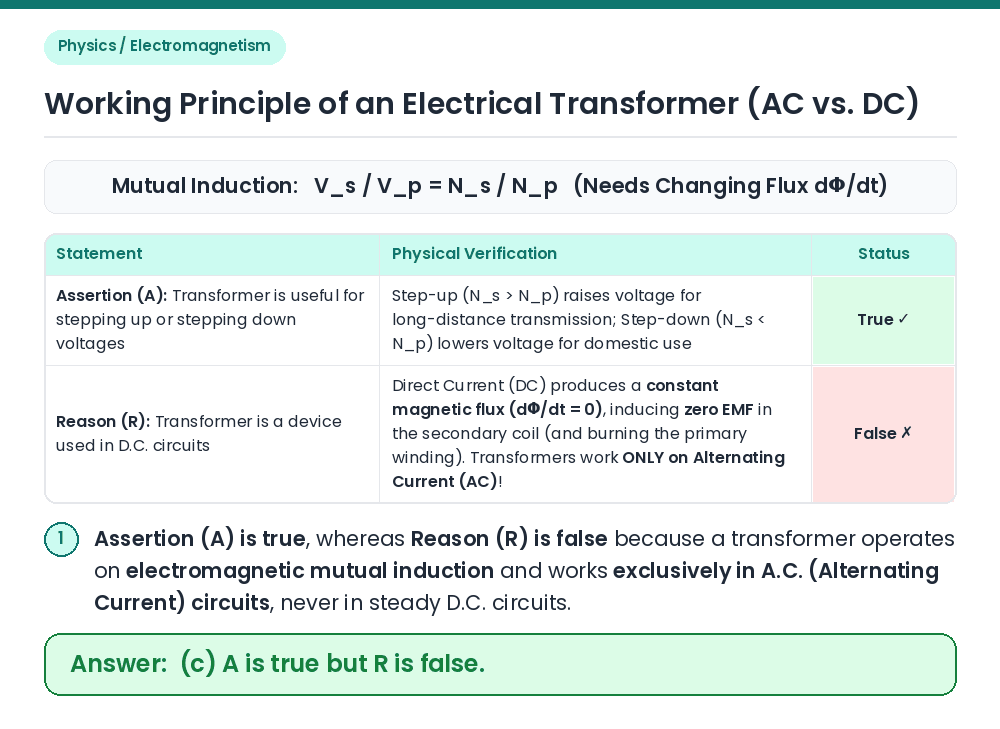
Assertion (A): Transformer is useful for stepping up or stepping down voltages. Reason (R): Transformer is a device used in D.C. circuits. In the context of the above two statements, which one of the following is correct?
उत्तर देखें और व्याख्याव्याख्या देखें
उत्तर: (C) A is true but R is false.
Concept: Examine the electromagnetic principle of a transformer (Faraday's law of mutual induction). Evaluate Assertion A: ⇒ A transformer steps up voltage (when secondary turns N_s > primary turns N_p) or steps down voltage (when N_s < N_p) according to V_s/V_p = N_s/N_p — so A is true. Evaluate Reason R: ⇒ Inducing an electromotive force in the secondary coil requires a continuously changing magnetic flux (e = −N dΦ/dt). Alternating Current (AC) constantly reverses direction and creates a time-varying flux, whereas steady Direct Current (DC) produces a constant flux (dΦ/dt = 0), so a transformer cannot work in a DC circuit — hence R is false. Result: A is true but R is false. Related Facts: • Energy Losses in a Transformer: Eddy current loss (minimised by using laminated soft-iron cores), hysteresis loss (minimised by using silicon steel/soft iron), copper/Joule heating loss, and flux leakage. Correct Answer: (c) A is true but R is false.