Civil Services Examination · प्रश्न 14
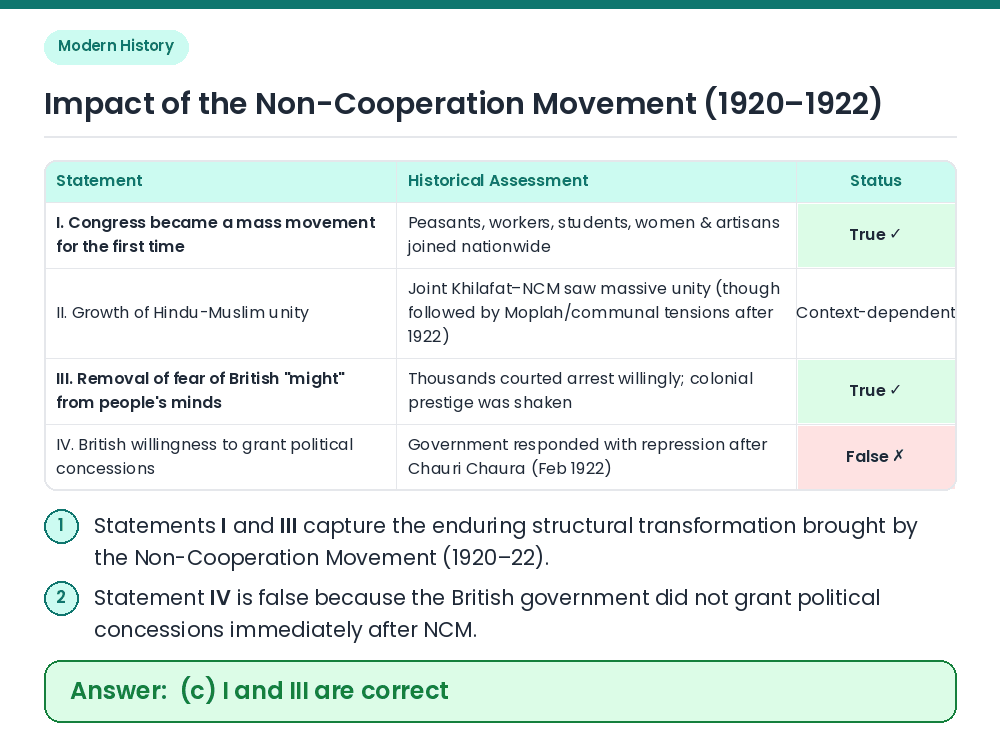
Consider the following statements: The Non-cooperation Movement led to the I. Congress becoming a mass movement for the first time. II. growth of Hindu Muslim unity. III. removal of fear of the British 'might' from the minds of the people. IV. British government's willingness to grant political concessions to Indians. Of these statements
उत्तर देखें और व्याख्याव्याख्या देखें
उत्तर: (C) I and III are correct
Concept: Assess the lasting political and psychological consequences of Mahatma Gandhi's Non-Cooperation Movement (1920–1922). Evaluate I & III: ⇒ Following the Nagpur Congress restructuring (December 1920), the Congress transformed from an elite deliberative body into a genuine mass movement (I is true), and mass Satyagraha/jail-going removed the psychological fear of British prisons and state power from the public mind (III is true). Evaluate IV & II: ⇒ The British government did not grant political concessions at the end of the movement (IV is false), leaving (c) I and III are correct as the valid combination of lasting structural outcomes. Result: Statements I and III are correct. Related Facts: • Nagpur Session (Dec 1920): Reorganised Provincial Congress Committees on a linguistic basis and introduced a 4-anna (25 paise) membership fee to enable mass enrollment. • Chauri Chaura Incident (February 1922): Led Mahatma Gandhi to suspend the Non-Cooperation Movement via the Bardoli Resolution (12 February 1922). Correct Answer: (c) I and III are correct