Civil Services Examination · प्रश्न 146
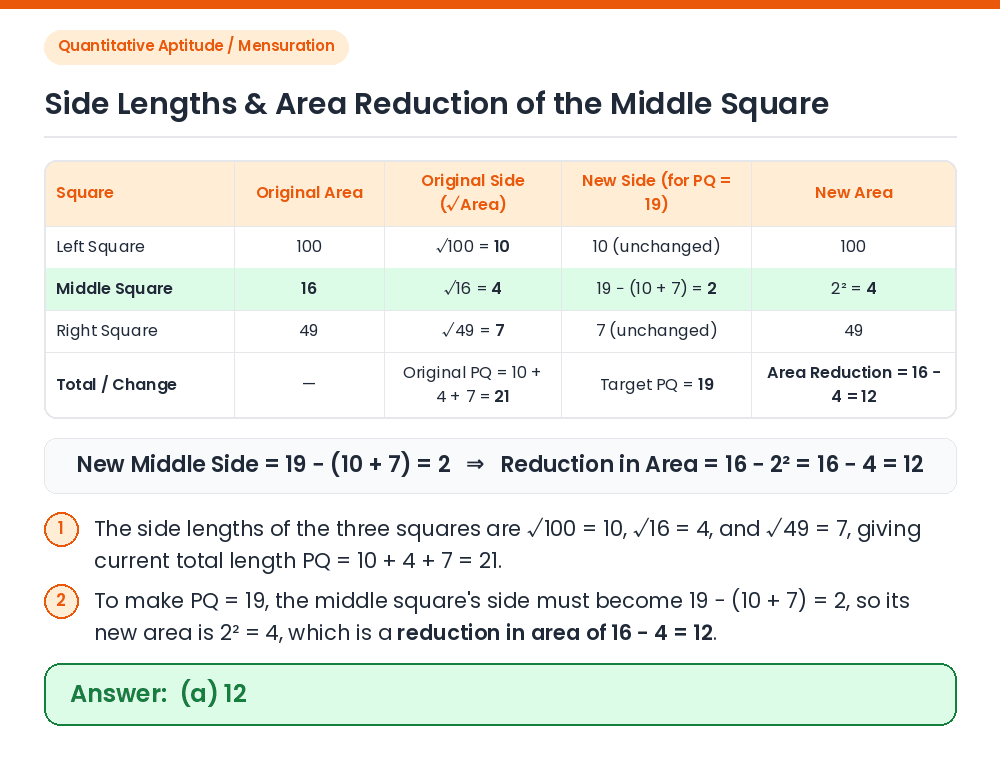
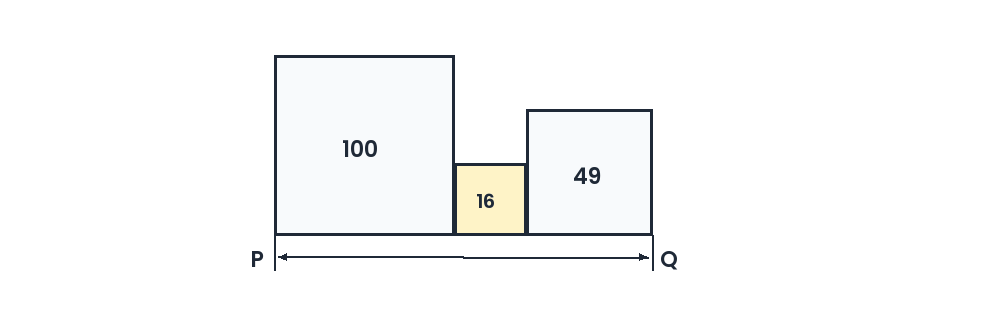
The following figure contains three squares with areas of 100, 16 and 49 lying side by side as shown. By how much should the area of the middle square be reduced in order that the total length PQ of the resulting three squares is 19?
उत्तर देखें और व्याख्याव्याख्या देखें
उत्तर: (A) 12
Given: Three squares placed side by side along line segment PQ have areas of 100, 16, and 49 respectively. Find Side Lengths: ⇒ Side of first square = √100 = 10; side of middle square = √16 = 4; side of third square = √49 = 7. Current total length PQ = 10 + 4 + 7 = 21. Find Required New Area & Reduction: ⇒ For the total length PQ to become 19, the new side of the middle square must be 19 − (10 + 7) = 2. Therefore, the new area of the middle square = 2² = 4, and the required reduction in its area = 16 − 4 = 12. Result: The area of the middle square should be reduced by 12. Shortcut: Don't confuse the new area (4) or new side (2) with the 'reduction in area' (16 − 4 = 12). Correct Answer: (a) 12