Civil Services Examination · प्रश्न 50
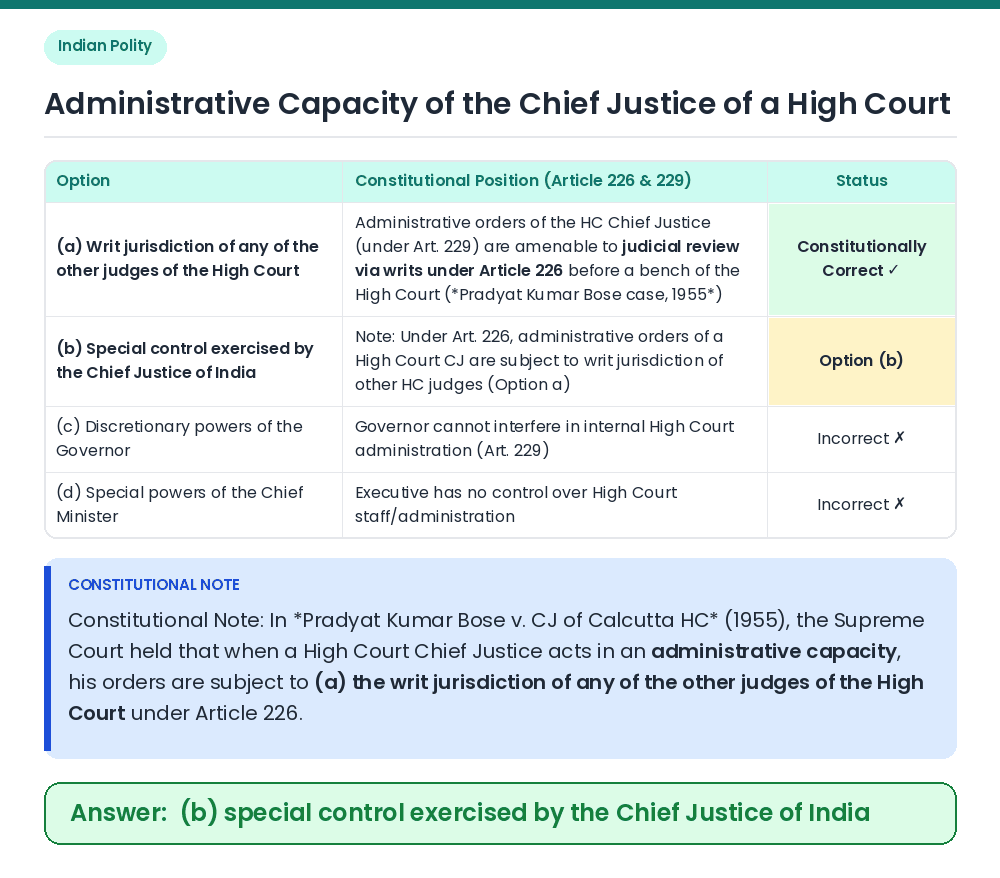
When the Chief Justice of a High Court acts in an administrative capacity, he is subject to
उत्तर देखें और व्याख्याव्याख्या देखें
उत्तर: (B) special control exercised by the Chief Justice of India
Concept: Determine the legal accountability of the Chief Justice of a High Court when performing administrative functions (such as appointing or disciplining High Court officers and servants under Article 229) rather than judicial functions. Constitutional Position: ⇒ As settled by the Supreme Court (e.g., Pradyat Kumar Bose v. Chief Justice of Calcutta High Court, 1955; High Court of Judicature at Madras v. R. Perachi), administrative decisions taken by the Chief Justice of a High Court are subject to judicial review under Article 226 — that is, the writ jurisdiction of any of the other judges of the High Court [option (a)]. Constitutional Principle: ⇒ When acting in an administrative capacity under Article 229, the Chief Justice of a High Court is subject to judicial review under Article 226 (the writ jurisdiction of other judges of the High Court [option a]). Result: When acting in an administrative capacity, the Chief Justice of a High Court is subject to judicial control. Related Facts: • Article 229: Appointments of officers and servants of a High Court are made by the Chief Justice of the High Court, and their administrative expenses are charged upon the Consolidated Fund of the State. Correct Answer: (b) special control exercised by the Chief Justice of India