Civil Services Examination · प्रश्न 64
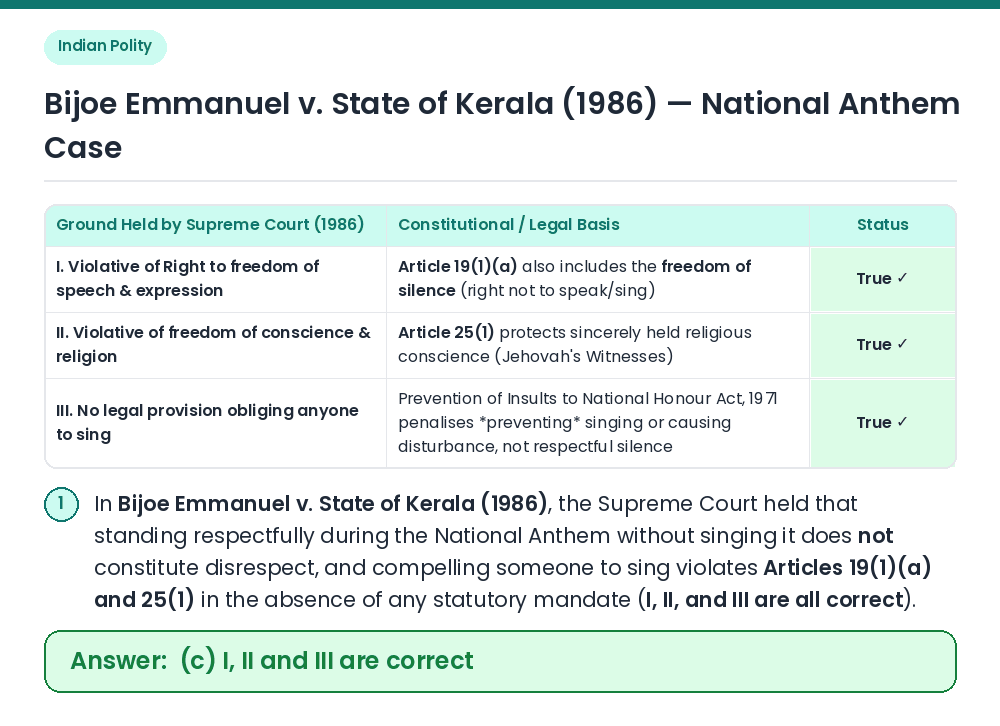
Consider the following statements: No one can be compelled to sing the National Anthem since I. it will be violative of the Right to freedom of speech and expression. II. it will be violative of the Right to freedom of conscience and practise and propagation of religion. III. there is no legal provision obliging any one to sing the National Anthem. Of these statements
उत्तर देखें और व्याख्याव्याख्या देखें
उत्तर: (C) I, II and III are correct
Concept: Recall the landmark Supreme Court judgment in Bijoe Emmanuel & Ors. v. State of Kerala (1986 SCR (3) 518), popularly known as the National Anthem Case. Evaluate I & II: ⇒ Three school children belonging to the Jehovah's Witnesses sect stood respectfully during the morning assembly National Anthem but did not sing due to their religious tenets. The Supreme Court ruled that expelling them violated (I) their Fundamental Right to Freedom of Speech and Expression under Article 19(1)(a) (which includes the right to remain silent) and (II) their Right to Freedom of Conscience and free profession/practice of religion under Article 25(1). Evaluate III: ⇒ The Court also explicitly noted that (III) there is no provision of law (including the Prevention of Insults to National Honour Act, 1971) which obliges anyone to sing the National Anthem, provided they stand up respectfully and cause no disturbance. Result: All three statements I, II and III are correct. Related Facts: • Closing Observation by Justice O. Chinnappa Reddy: 'Our tradition teaches tolerance; our philosophy preaches tolerance; our Constitution practices tolerance; let us not dilute it.' Correct Answer: (c) I, II and III are correct