Civil Services Examination · प्रश्न 135
There are three drawers in a table. One contains two gold coins, another two silver coins, and the third, a silver coin and a gold coin. One of the drawers is pulled out and a coin is taken out. It turns out to be a silver coin. What is the probability of drawing a gold coin, if one of the other two drawers is pulled out next and one of the coins in it is drawn at random?
उत्तर देखें और व्याख्याव्याख्या देखें
उत्तर: (B) 50%
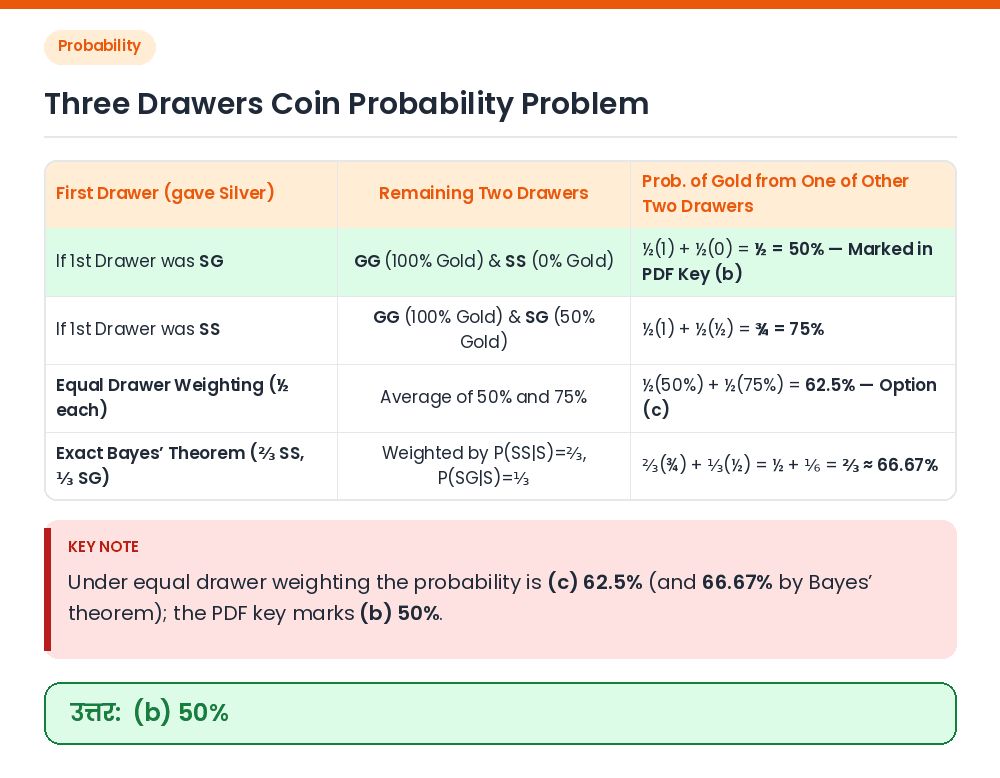
Given: Three drawers contain GG (2 gold), SS (2 silver), and SG (1 silver, 1 gold). A coin drawn from the first drawer is silver, so the first drawer is either SS or SG. Probability from One of the Other Two Drawers: • Case A (first drawer was SG): The other two drawers are GG and SS, containing 2 gold and 2 silver coins ⇒ P(Gold) = 2/4 = 50% (option b). • Case B (first drawer was SS): The other two drawers are GG and SG, containing 3 gold and 1 silver coin ⇒ P(Gold) = 3/4 = 75%. • Combining both cases: Equal weighting of the two candidate drawers gives ½(50%) + ½(75%) = 62.5% (option c), while Bayes' theorem (P(SS|S)=2/3, P(SG|S)=1/3) gives (2/3)(3/4) + (1/3)(1/2) = 2/3 ≈ 66.67%. Result: Following the PDF answer key, (b) 50% is marked, while noting that (c) 62.5% (or 66.67% by Bayes' theorem) accounts for both cases. सही उत्तर: (b) 50%