Civil Services Examination · प्रश्न 112
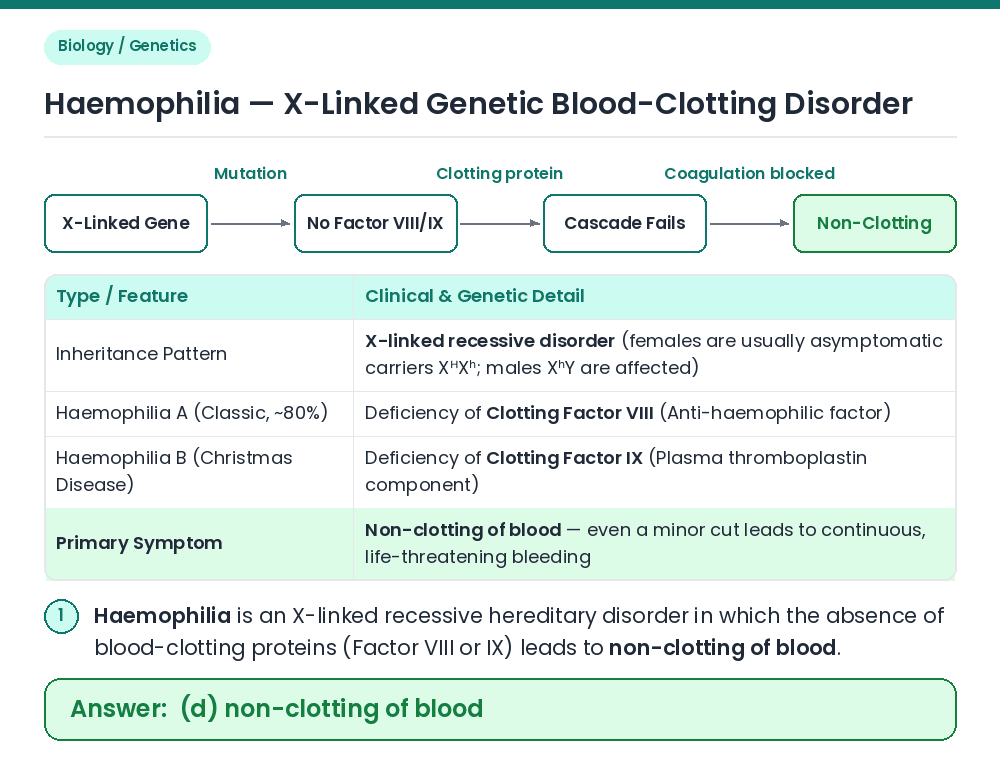
Haemophilia is a genetic disorder which leads to:
उत्तर देखें और व्याख्याव्याख्या देखें
उत्तर: (D) non-clotting of blood
Given / Concept: Haemophilia (also known as the 'Royal Disease') is a sex-linked (X-chromosome-linked) recessive genetic disorder. Pathophysiology: In affected individuals, a mutation on the X chromosome impairs the synthesis of essential blood coagulation proteins — Factor VIII (in Haemophilia A) or Factor IX (in Haemophilia B). Clinical Consequence: Because the coagulation cascade cannot convert fibrinogen into an insoluble fibrin mesh efficiently, blood fails to clot normally after an injury, leading to prolonged haemorrhage. Result: Haemophilia leads to non-clotting of blood. Related Facts: • Why Called the 'Royal Disease': Queen Victoria of Britain was a carrier of Haemophilia B and passed the mutant X-linked allele to several royal houses across Europe (Spain, Russia, and Prussia). • Vitamin Required for Blood Clotting: Vitamin K (phylloquinone) is essential for the synthesis of prothrombin (Factor II) and Factors VII, IX, and X in the liver. Correct Answer: (d) non-clotting of blood