Civil Services Examination · प्रश्न 74
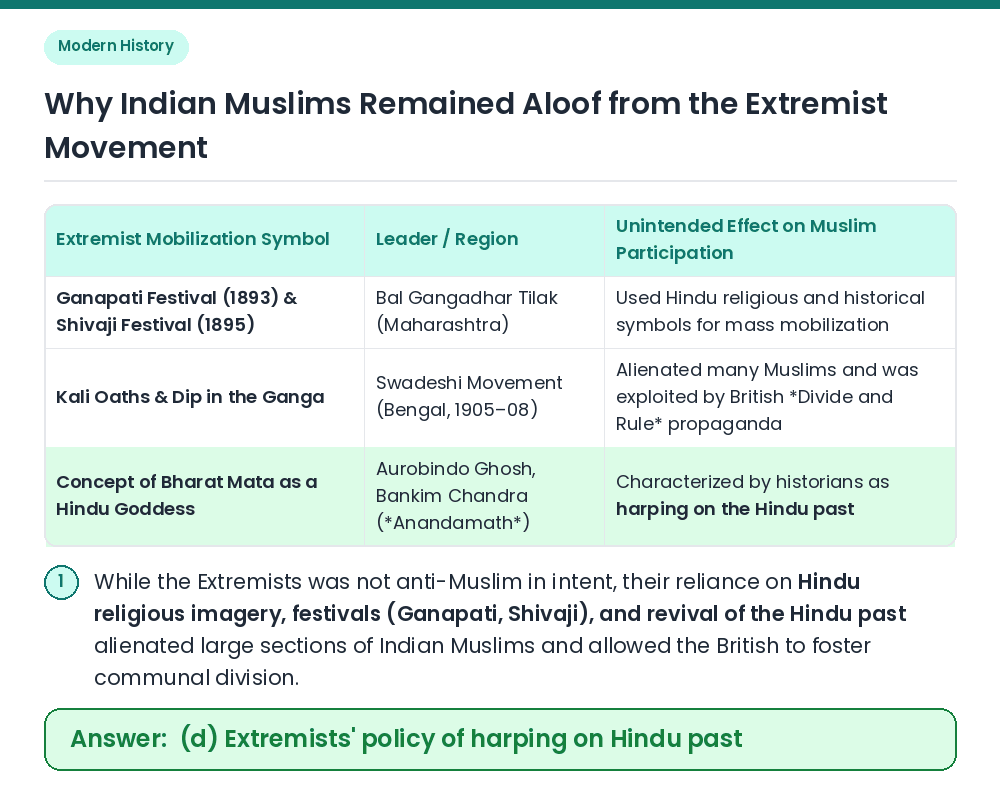
The Indian Muslims, in general, were not attracted to the Extremist movement because of the:
उत्तर देखें और व्याख्याव्याख्या देखें
उत्तर: (D) Extremists' policy of harping on Hindu past
Given / Concept: During the Swadeshi and Militant Nationalist (Extremist) phase (1905–1908), leaders like Tilak, Aurobindo Ghosh, and Bipin Chandra Pal sought to transform nationalism from an elite chamber movement into a mass struggle. Religious Idiom Used: To arouse mass enthusiasm rapidly, Extremist leaders drew heavily on Hindu religious symbols, festivals, and ancient/medieval glories — such as Tilak's Ganapati and Shivaji festivals, oaths taken before Goddess Kali, sacred dips in the Ganga, and equating the nation with a Hindu goddess. Consequence: Although Extremist leaders were not personally anti-Muslim (Tilak later championed the 1916 Lucknow Pact), this policy of harping on the Hindu past failed to attract the Muslim masses and was exploited by colonial authorities. Result: Indian Muslims, in general, were not attracted to the Extremist movement because of the Extremists' policy of harping on the Hindu past. Related Facts: • Prominent Muslims in the Swadeshi Movement: Despite limited mass Muslim participation, leaders like Barrister Abdul Rasul, Liaqat Husain, Guznavi, and Maulana Abul Kalam Azad actively supported the Swadeshi agitation. • Formation of Muslim League (Dec 1906): Founded at Dacca by Nawab Salimullah, Aga Khan III, and Mohsin-ul-Mulk during the height of the Partition of Bengal controversy. Correct Answer: (d) Extremists' policy of harping on Hindu past