Civil Services Examination · प्रश्न 85
Which one of the following defines extremist ideology during the early phase of Indian freedom movement?
उत्तर देखें और व्याख्याव्याख्या देखें
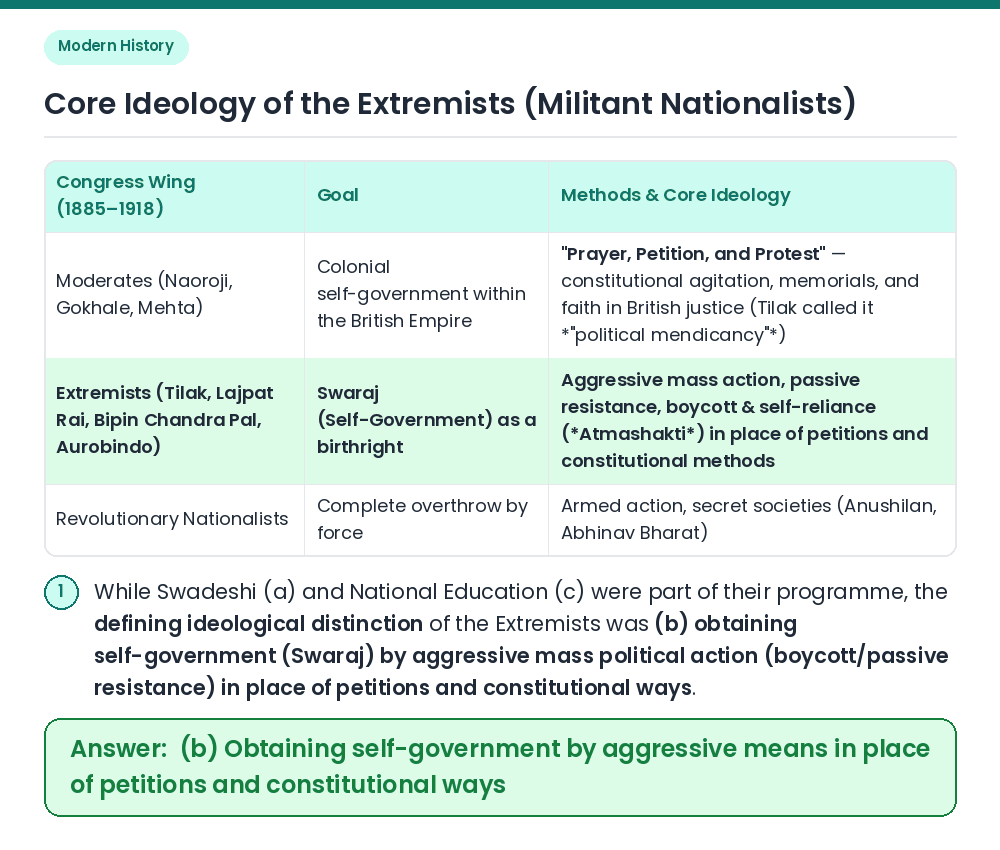
उत्तर: (B) Obtaining self-government by aggressive means in place of petitions and constitutional ways
Given / Concept: Compare the core political ideology of the Extremist (Militant Nationalist) school (led by Lal–Bal–Pal and Aurobindo Ghosh) with that of the Moderates and Revolutionaries. Distinguish from Moderates: The Moderates relied on constitutional methods of 'prayer, petition, and protest'; the Extremists rejected this 'political mendicancy' and defined their creed as winning Swaraj (self-government) through assertive/aggressive mass struggle, boycott, and passive resistance. Distinguish Other Options: Options (a) Swadeshi and (c) National Education were specific tools also endorsed by Moderates in 1906, while (d) armed military coups belonged to revolutionary nationalists (like the Ghadarites), not the Congress Extremists. Result: Extremist ideology is defined by obtaining self-government by aggressive means in place of petitions and constitutional ways. Related Facts: • Tilak's Maxim: 'Swaraj is my birthright and I shall have it!' • Aurobindo Ghosh's 'New Lamps for Old' (1893–94): Series of articles in Indu Prakash offering the earliest systematic critique of Moderate 'mendicancy'. Correct Answer: (b) Obtaining self-government by aggressive means in place of petitions and constitutional ways