Civil Services Examination · प्रश्न 12
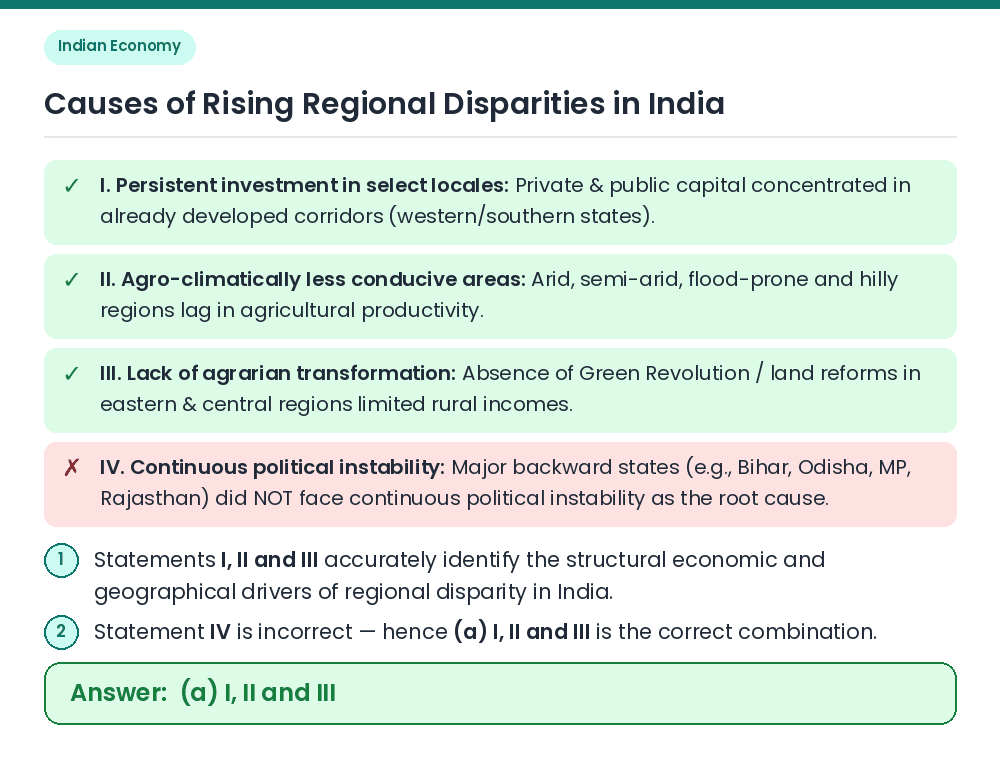
Consider the following statements: Regional disparities in India are high and have been rising in recent years because I. there is persistent investment over time only in select locales. II. some areas are agro-climatically less conducive to development. III. some areas continue to face little or no agrarian transformation and the consequent lack of social and economic opportunities. IV. some areas have faced continuous political instability. Which of the above statements are correct?
उत्तर देखें और व्याख्याव्याख्या देखें
उत्तर: (A) I, II and III
Concept: Post-liberalisation regional disparities in India widened due to agglomeration economies, agro-climatic differences, and uneven agrarian transformation. Evaluate I, II, and III: Cumulative investment in developed industrial clusters (I), unfavourable agro-climatic zones such as rainfed/drought-prone regions (II), and weak agrarian transformation in eastern/central India (III) are all well-established causes of regional divergence. Evaluate IV: Continuous political instability (IV) is not a general cause explaining the economic lag of major backward states across India. Result: Statements I, II and III are correct. Related Facts: • Freight Equalisation Policy (1952–1993): Subsidised mineral transport across India, removing the natural locational advantage of mineral-rich eastern states (Bihar/Jharkhand, Odisha, West Bengal). • Green Revolution Concentration: Early gains of HYV seeds and assured irrigation were heavily concentrated in Punjab, Haryana, and Western UP. Correct Answer: (a) I, II and III