Civil Services Examination · प्रश्न 39
The planning process in the industrial sector in India has assumed a relatively less important position in the nineties as compared to that in the earlier period. Which one of the following is true in this regard?
उत्तर देखें और व्याख्याव्याख्या देखें
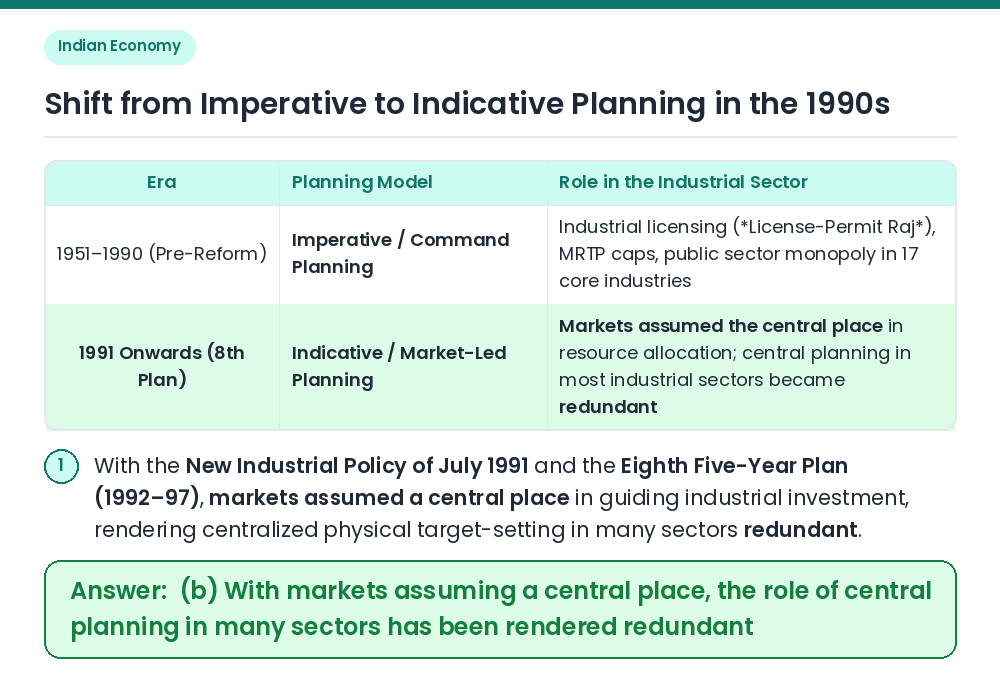
उत्तर: (B) With markets assuming a central place, the role of central planning in many sectors has been rendered redundant
Concept: Following the 1991 economic reforms (Liberalisation, Privatisation, and Globalisation) and the launch of the Eighth Five-Year Plan (1992–97), India transitioned from directive/imperative planning to indicative planning. Role of Markets: Abolition of industrial licensing for all but a few strategic industries, dismantling of MRTP asset limits, and price decontrol meant that market signals (price and profit mechanisms) assumed the central role in allocating industrial investment. Effect on Central Planning: Consequently, centralized state planning of capacity and output targets in most industrial sectors became redundant. Result: With markets assuming a central place, the role of central planning in many sectors has been rendered redundant. Related Facts: • Eighth Five-Year Plan (1992–97): Formulated under Pranab Mukherjee (Deputy Chairman, Planning Commission), it explicitly adopted the French-style 'Indicative Planning' model. Correct Answer: (b) With markets assuming a central place, the role of central planning in many sectors has been rendered redundant