Civil Services Examination · प्रश्न 97
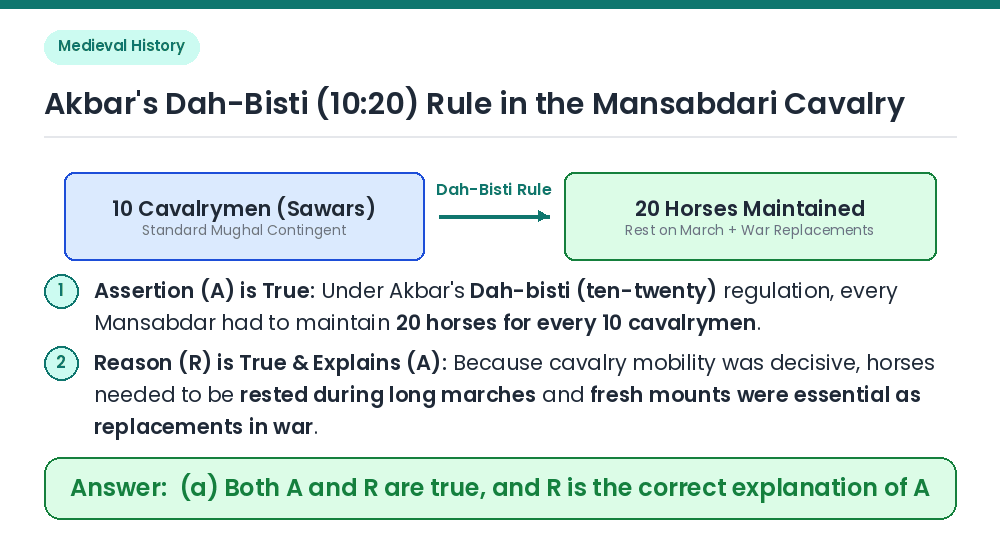
Assertion (A): During the time of Akbar, for every ten cavalrymen, the mansabdars had to maintain twenty horses. Reason (R): Horses had to be rested while on march and replacements were necessary in times of war.
उत्तर देखें और व्याख्याव्याख्या देखें
उत्तर: (A) Both A and R are true, and R is the correct explanation of A
Concept: Examine the 'Dah-bisti' (ten-twenty) rule introduced by Emperor Akbar in the Mughal Mansabdari military system. Evaluate Assertion A: Under Akbar's Mansabdari regulations, a regular contingent required maintaining twenty horses for every ten cavalrymen (sawars) — hence Assertion (A) is true. Evaluate Reason R: This 2:1 horse-to-trooper ratio was enforced because a single horse tired quickly on long forced marches and spare mounts were vital for immediate replacement during battle — hence Reason (R) is true and directly explains Assertion (A). Result: Both A and R are true, and R is the correct explanation of A. Related Facts: • Dagh and Chehra: Akbar enforced branding of horses (Dagh) and descriptive rolls of soldiers (Chehra) to prevent Mansabdars from presenting borrowed horses at muster. • Du-aspa Sih-aspa: Later introduced by Emperor Jahangir, allowing selected Mansabdars to maintain double or triple the standard horse quota without raising their Zat rank. Correct Answer: (a) Both A and R are true, and R is the correct explanation of A