Civil Services Examination · प्रश्न 126
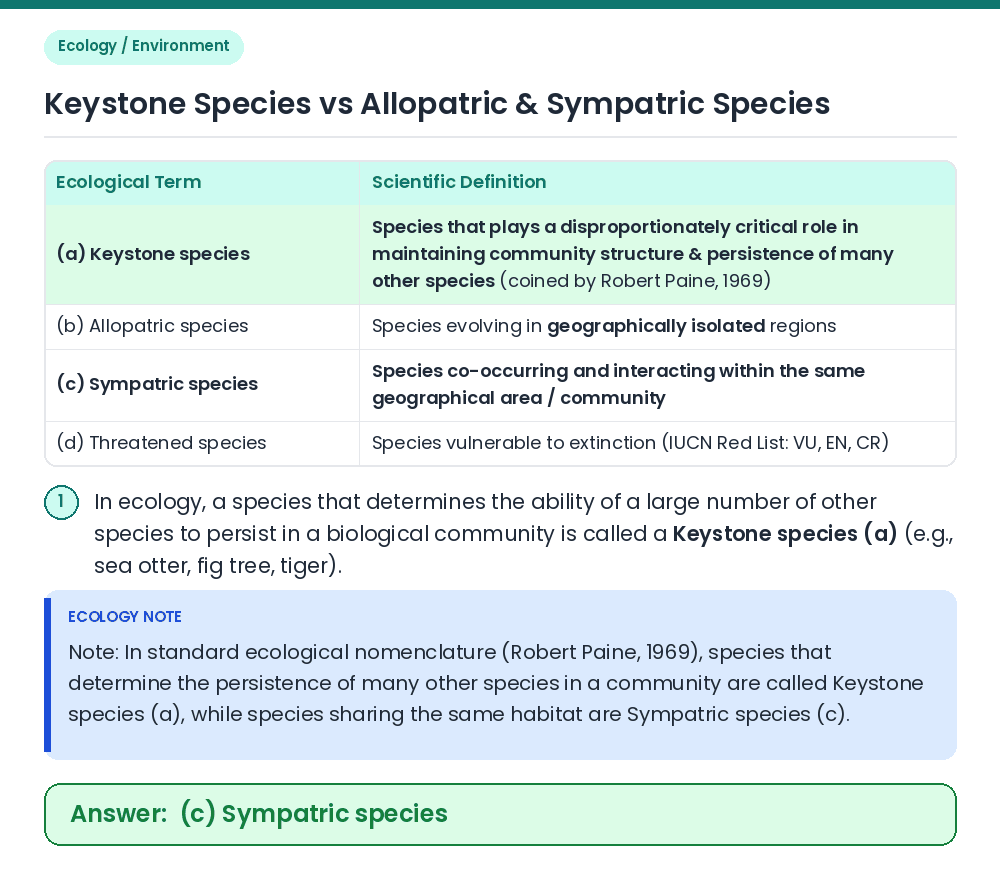
Within biological communities, some species are important in determining the ability of a large number of other species to persist in the community. Such species are called
उत्तर देखें और व्याख्याव्याख्या देखें
उत्तर: (C) Sympatric species
Concept: In community ecology, certain species exert an influence on biodiversity and community structure that is disproportionately large relative to their abundance. Ecological Definition: Coined by zoologist Robert T. Paine in 1969 (studying the predatory starfish Pisaster ochraceus), a 'Keystone species' determines the ability of a large number of other species to persist in the biological community. Result: While such pivotal species are termed Keystone species (a) in ecological literature, Sympatric species (c) refers to species coexisting within the same community. Related Facts: • Examples of Keystone Species: Sea otters in kelp forests, fig trees in tropical rainforests, African elephants in savannas, and apex predators like tigers and wolves. • Allopatric vs Sympatric: Allopatric speciation occurs with geographic isolation, whereas sympatric speciation occurs within the same geographic area. Correct Answer: (c) Sympatric species