Civil Services Examination · प्रश्न 138
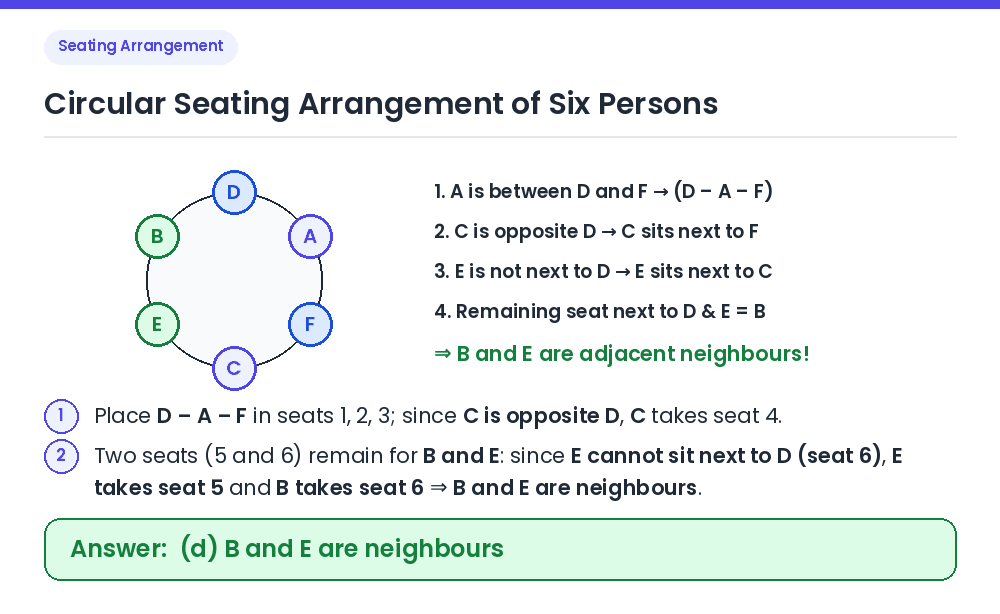
A, B, C, D, E and F, not necessarily in that order, are sitting in six chairs regularly placed around a round table. It is observed that A is between D and F. C is opposite D. D and E are not on neighbouring chairs. Which one of the following must be true?
उत्तर देखें और व्याख्याव्याख्या देखें
उत्तर: (D) B and E are neighbours
Given: Six chairs numbered 1 to 6 clockwise around a round table; A is between D and F, C is opposite D, and D and E are not neighbours. Fix Positions: Place D at Chair 1, A at Chair 2, and F at Chair 3 (so A is between D and F) ⇒ Since C is opposite D (3 seats away), C is at Chair 4. Place E and B: The two remaining adjacent chairs are Chair 5 (next to C) and Chair 6 (next to D). Because D and E are not neighbours, E cannot sit in Chair 6 ⇒ E sits in Chair 5 and B sits in Chair 6. Result: Sitting in Chairs 5 and 6, B and E are neighbours (also A is opposite E, C is neighbours with F and E). Correct Answer: (d) B and E are neighbours