Civil Services Examination · प्रश्न 148
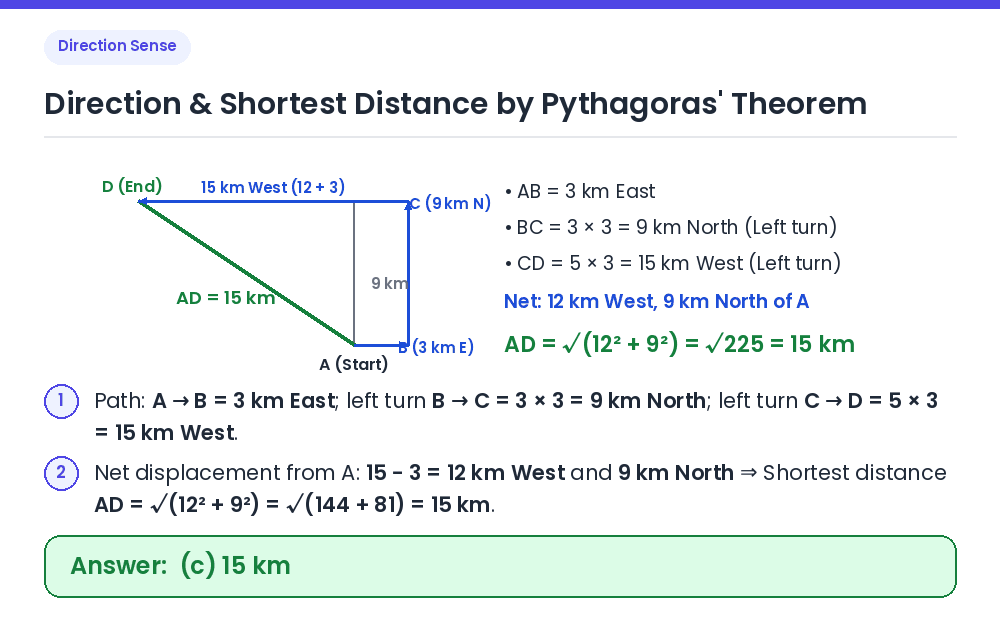
A person starts from a point A and travels 3 km eastwards to B and then turns left and travels thrice that distance to reach C. He again turns left and travels five times the distance he covered between A and B and reaches his destination D. The shortest distance between the starting point and destination is
उत्तर देखें और व्याख्याव्याख्या देखें
उत्तर: (C) 15 km
Given: Take starting point A as the origin (0, 0). Trace Movements: ⇒ A to B: 3 km East → B is at (3, 0) ⇒ B to C (left turn from East = North): 3 × 3 = 9 km North → C is at (3, 9) ⇒ C to D (left turn from North = West): 5 × 3 = 15 km West → D is at (3 − 15, 9) = (−12, 9) Calculate Shortest Distance AD: By Pythagoras' theorem: ⇒ AD = √((−12)² + 9²) = √(144 + 81) = √225 = 15 km Result: The shortest distance between the starting point and destination is 15 km. Shortcut: Recognise the 3–4–5 Pythagorean triple scaled by 3: legs are 9 km (3×3) and 12 km (3×4), so hypotenuse = 3×5 = 15 km. Correct Answer: (c) 15 km