Civil Services Examination · प्रश्न 56
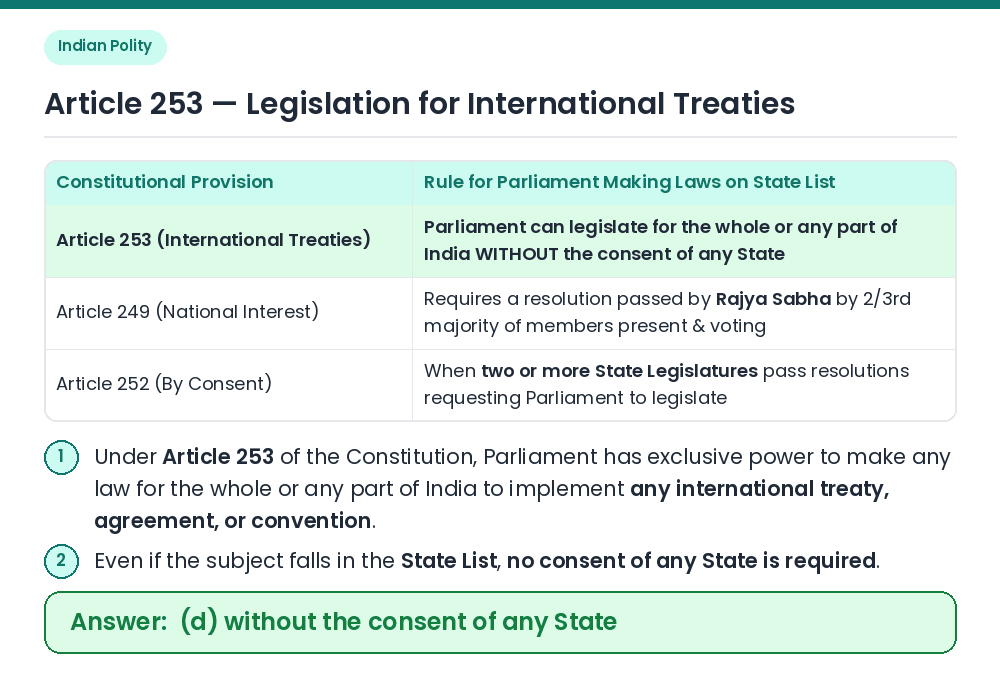
The Parliament can make any law for the whole or any part of India for implementing international treaties
उत्तर देखें और व्याख्याव्याख्या देखें
उत्तर: (D) without the consent of any State
Concept: Article 253 in Part XI of the Constitution empowers Parliament to enact legislation for giving effect to international agreements, treaties, and conventions. Constitutional Rule: Notwithstanding the normal distribution of legislative powers between the Union and the States, Parliament can enact laws under Article 253 even on subjects enumerated in the State List without requiring the consent of any State. Result: Parliament can make such laws without the consent of any State. Related Facts: • Examples of Laws Enacted under Art. 253: Environment (Protection) Act 1986 (Stockholm Conference), TRIPS-compliant Patent Amendments, and the Lokpal and Lokayuktas Act 2013 (UN Convention against Corruption). • Article 51(c) (DPSP): Directs the State to foster respect for international law and treaty obligations. Correct Answer: (d) without the consent of any State