Civil Services Examination · प्रश्न 84
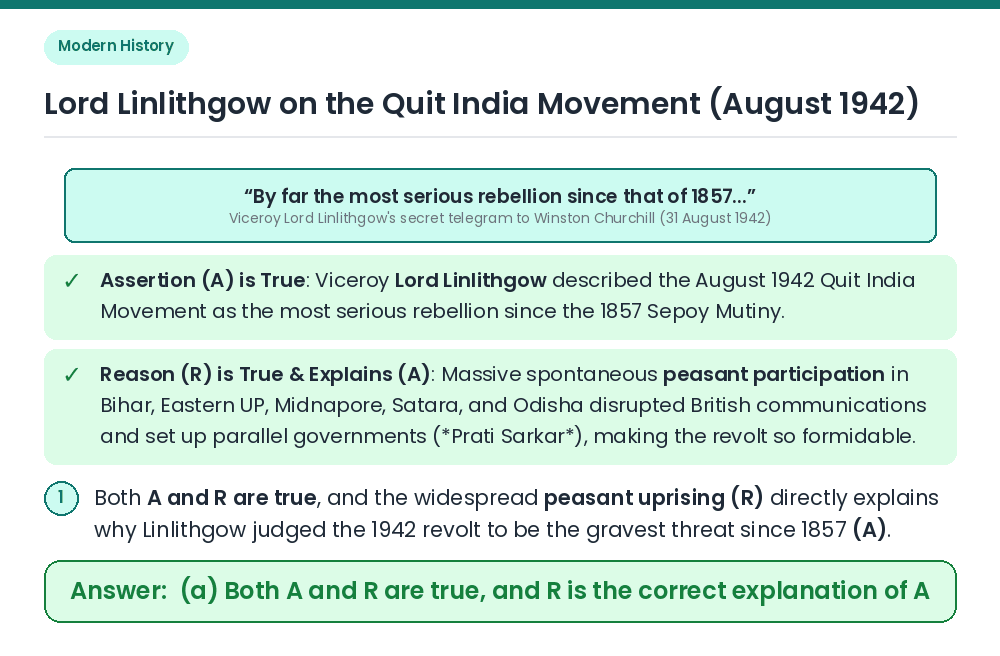
Assertion (A): Lord Linlithgow described the August Movement of 1942 as the most serious revolt after the Sepoy mutiny. Reason (R): Peasants joined the movement in large number in some places.
उत्तर देखें और व्याख्याव्याख्या देखें
उत्तर: (A) Both A and R are true, and R is the correct explanation of A
Concept: In a famous telegram dated 31 August 1942 to British Prime Minister Winston Churchill, Viceroy Lord Linlithgow wrote: 'I am engaged here in meeting by far the most serious rebellion since that of 1857, the gravity and extent of which we have so far concealed from the world for reasons of military security.' Evaluate A & R: Assertion (A) is historically true ⇒ Reason (R) is also true, as peasants across Bihar, Eastern UP, Bengal (Tamluk), Maharashtra (Satara), and Odisha joined the movement in massive numbers, attacking police stations, railway lines, and telegraph networks. Causal Link & Result: This massive rural and peasant participation transformed the movement into an all-out rebellion that paralysed colonial rule in whole districts, explaining why Linlithgow compared its gravity to 1857. Related Facts: • Parallel Governments (1942–44): Ballia (Chittu Pandey), Tamluk Jatiya Sarkar in Midnapore (Satish Samanta), and Satara Prati Sarkar (Nana Patil & Y. B. Chavan). • Launch Date: Quit India Resolution was passed at Gowalia Tank Maidan, Bombay on 8 August 1942. Correct Answer: (a) Both A and R are true, and R is the correct explanation of A