Civil Services Examination · प्रश्न 97
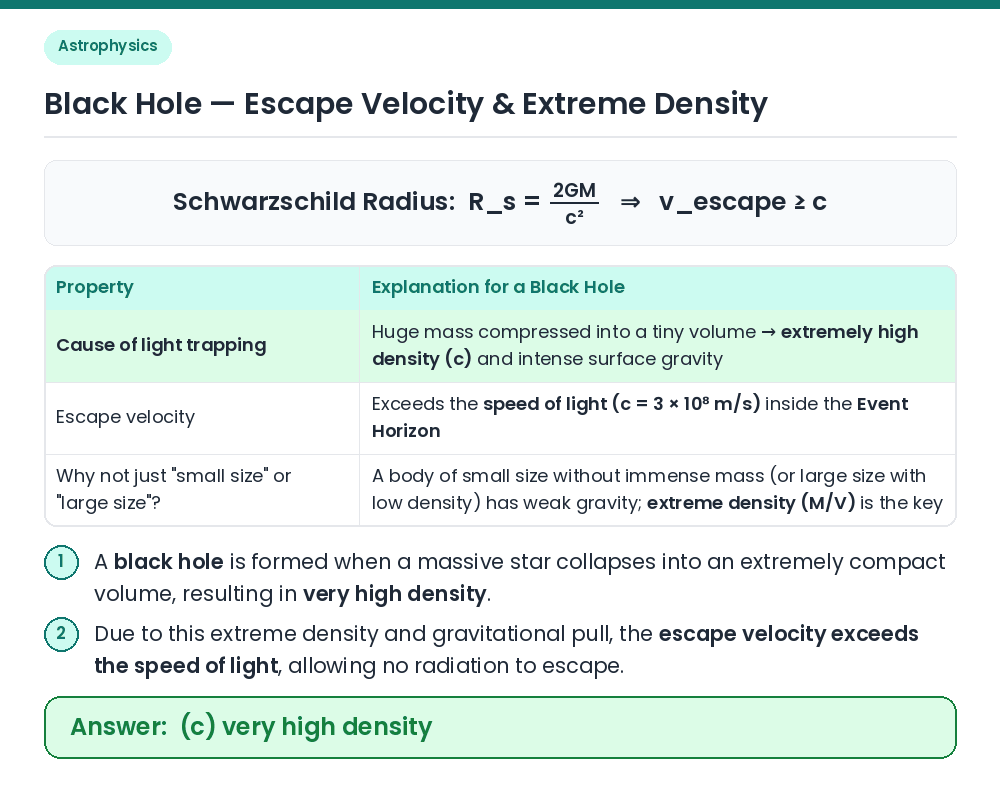
A ‘black hole’ is a body in space which does not allow any radiation to come out. This property is due to its
उत्तर देखें और व्याख्याव्याख्या देखें
उत्तर: (C) very high density
Concept: A black hole is a region of spacetime formed by the gravitational collapse of a massive star where matter is compressed within its Schwarzschild radius (R_s = 2GM/c²). Physical Reason: Because an enormous mass is packed into an extremely small volume, the body attains a very high density and an intense gravitational field whose escape velocity exceeds the speed of light (c = 3 × 10⁸ m/s). Result: This property is due to its very high density. Related Facts: • Chandrasekhar Limit (1.44 Solar Masses): Maximum mass of a stable white dwarf star, discovered by Indian-American astrophysicist Subrahmanyan Chandrasekhar (Nobel Prize, 1983). • Term 'Black Hole': Popularized by physicist John Archibald Wheeler in 1967; Hawking radiation was theorized by Stephen Hawking in 1974. Correct Answer: (c) very high density