Civil Services Examination · प्रश्न 144
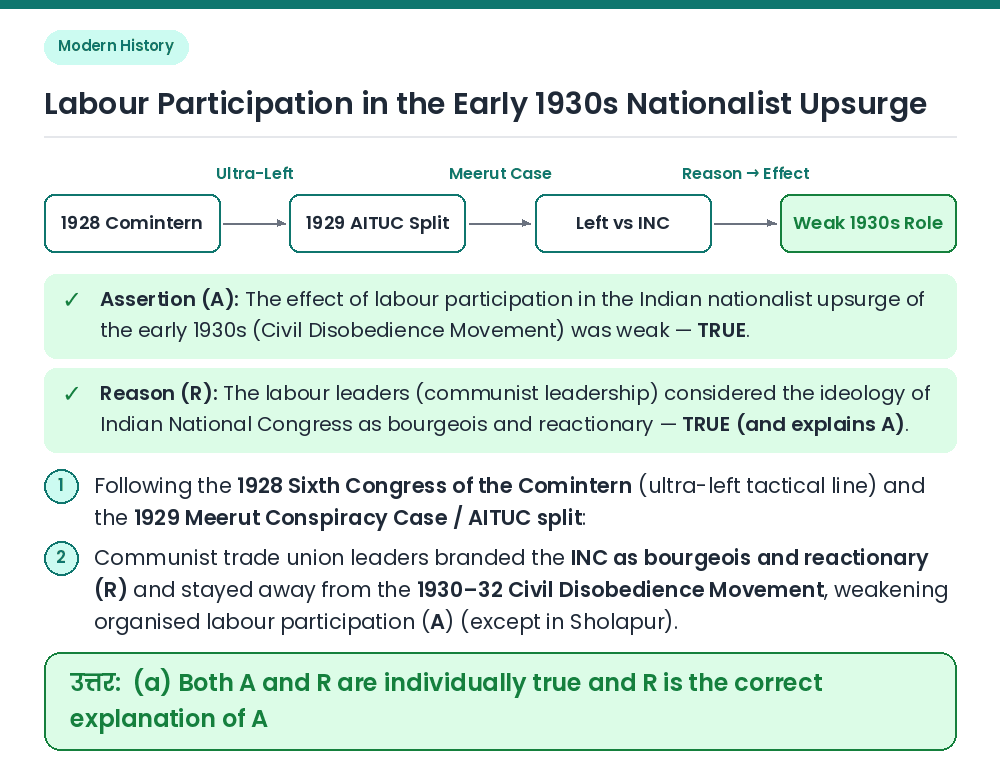
Assertion (A): The effect of labour participation in the Indian nationalist upsurge of the early 1930s was weak. Reason (R): The labour leaders considered the ideology of Indian National Congress as bourgeois and reactionary.
उत्तर देखें और व्याख्याव्याख्या देखें
उत्तर: (A) Both A and R are individually true and R is the correct explanation of A
Given / Concept: Analysing working-class participation during the Civil Disobedience Movement (1930–1934) compared to the strike wave of 1928–29. Evaluating A and R: After the massive labour upsurge of 1928, working-class participation in the nationalist upsurge of the early 1930s was noticeably weaker (except notably in Sholapur, Nagpur, and Bombay early on), so Assertion (A) is true. Following the Sixth Congress of the Communist International (Comintern) in 1928, communist labour leaders adopted an ultra-left sectarianism that characterised the Indian National Congress as a 'bourgeois and reactionary' party and severed ties with the Congress-led national movement, splitting the AITUC in 1929 and 1931. Causal Link: This ideological break (along with the arrest of 31 top labour leaders in the 1929 Meerut Conspiracy Case) directly explains why organised labour participation in the early 1930s nationalist upsurge was weak. Result: Both A and R are individually true and R is the correct explanation of A. Related Facts: • Sholapur Textile Workers' Strike (May 1930): Following Gandhi's arrest, textile workers in Sholapur staged a militant uprising and established a virtual parallel administration before martial law was imposed. सही उत्तर: (a) Both A and R are individually true and R is the correct explanation of A