Civil Services Examination · प्रश्न 47
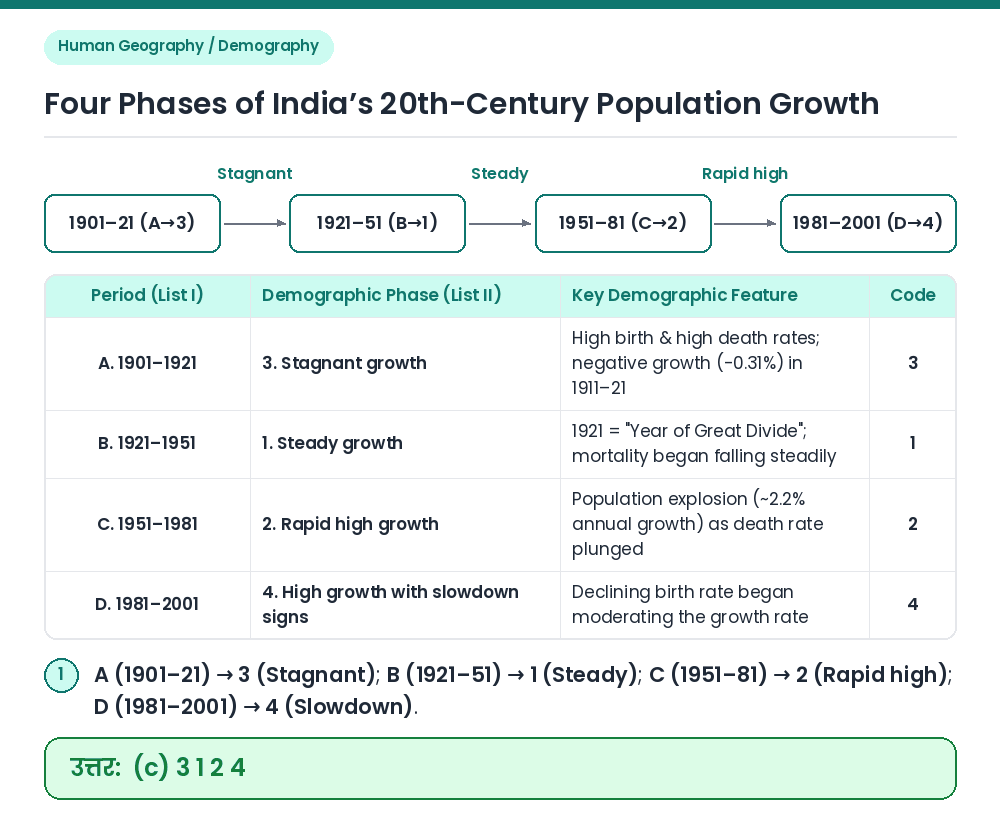
India’s population growth during the 20th century can be classified into four distinct phases. Match List I (Period) with List II (Phase) and select the correct answer using the codes given below the lists: List I (Period) — List II (Phase) A. 1901-21 — 1. Steady growth B. 1921-51 — 2. Rapid high growth C. 1951-81 — 3. Stagnant growth D. 1981-2001 — 4. High growth with definite signs of slowdown Codes (A B C D):
उत्तर देखें और व्याख्याव्याख्या देखें
उत्तर: (C) 3 1 2 4
Given / Concept: Demographic history of India in the 20th century is divided into four distinct census phases. Matching A & B: Phase I (1901–1921) was a period of stagnant or stationary growth marked by famines and the 1918 influenza pandemic (A → 3). Phase II (1921–1951), following the 1921 'Year of the Great Divide', witnessed steady population growth as sanitation and healthcare improved (B → 1). Matching C & D: Phase III (1951–1981) experienced rapid high growth (population explosion) due to a steep fall in mortality while fertility remained high (C → 2). Phase IV (1981–2001) saw high growth with definite signs of a downward trend in birth rates (D → 4). Result: The correct code is A–3, B–1, C–2, D–4, which is 3 1 2 4. Related Facts: • 1911–1921 Decade: The only census decade in modern Indian history to record a negative population growth rate (-0.31%). सही उत्तर: (c) 3 1 2 4