Civil Services Examination · प्रश्न 17
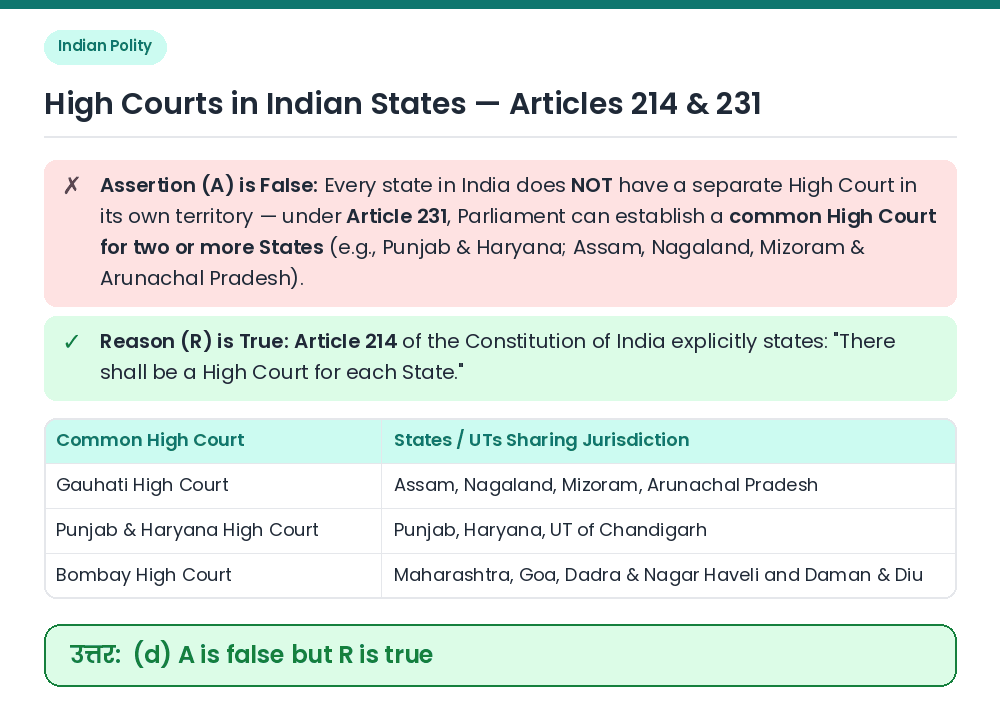
Assertion (A): In India, every state has a High Court in its territory. Reason (R): The Constitution of India provides for a High Court in each state.
उत्तर देखें और व्याख्याव्याख्या देखें
उत्तर: (D) A is false but R is true
Given / Concept: Examine Articles 214 and 231 of the Constitution regarding High Courts for States. Evaluate A: In fact, every State does NOT have a separate High Court located within its territory. Under the 7th Constitutional Amendment Act, 1956 (Article 231), Parliament is empowered to establish a common High Court for two or more States (for instance, Punjab and Haryana share a High Court at Chandigarh; Nagaland, Mizoram, and Arunachal Pradesh share the Gauhati High Court in Assam; Goa shares the Bombay High Court) ⇒ A is false. Evaluate R: Article 214 of the Constitution of India explicitly provides that 'There shall be a High Court for each State' ⇒ R is true. Result: A is false, but R is true. Related Facts: • Total High Courts in India: Currently there are 25 High Courts across 28 States and 8 Union Territories. सही उत्तर: (d) A is false but R is true