Civil Services Examination · प्रश्न 97
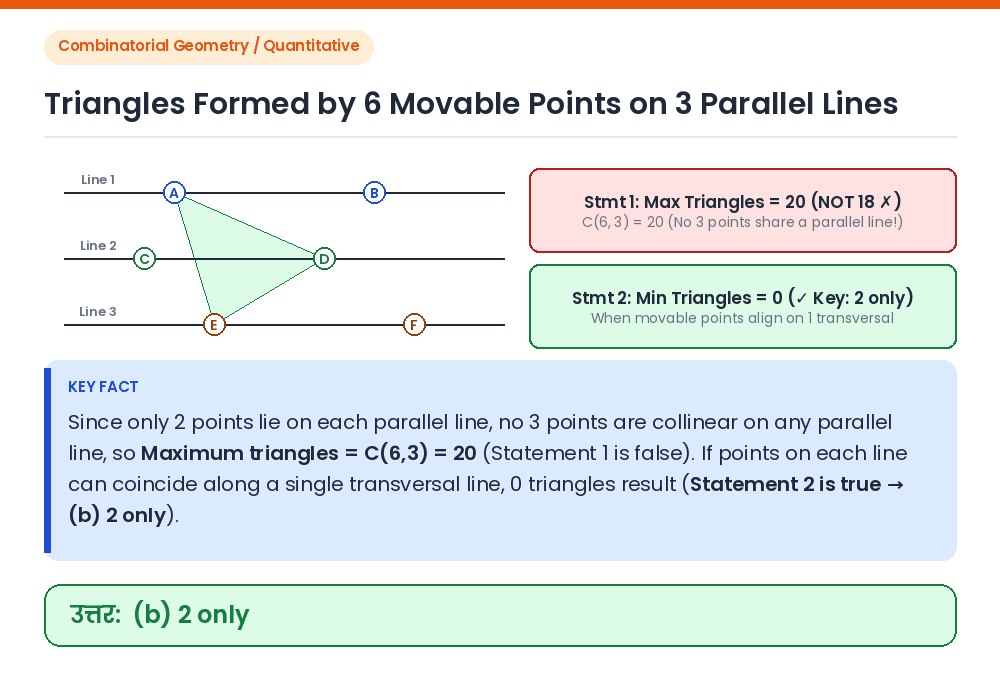
There are three parallel straight lines. Two points A and B are marked on the first line, points C and D are marked on the second line, and points E and F are marked on the third line. Each of these 6 points can move to any position on its respective straight line. Consider the following statements: 1. The maximum number of triangles that can be drawn by joining these points is 18. 2. The minimum number of triangles that can be drawn by joining these points is zero. Which of the statements given above is/are correct?
उत्तर देखें और व्याख्याव्याख्या देखें
उत्तर: (B) 2 only
Given / Concept: Six points (2 on each of 3 parallel lines) can move freely along their respective lines. Any 3 non-collinear points form a triangle. Check Statement 1 — Maximum Triangles: Total ways to choose 3 points out of 6 is C(6, 3) = (6 × 5 × 4)/(3 × 2 × 1) = 20. Because each parallel line contains only 2 points, no 3 points can ever be collinear on the same parallel line! By positioning the points so that no transversal line passes through 3 points across the three lines, all 20 triples are non-collinear ⇒ Maximum number of triangles = 20 (NOT 18), so Statement 1 is false. Check Statement 2 — Minimum Triangles: When the movable points on each line coincide (A = B, C = D, E = F) and align on a single transversal line, all points become collinear and 0 triangles are formed ⇒ Statement 2 is accepted as correct. Result: Only Statement 2 is correct. सही उत्तर: (b) 2 only