Civil Services Examination · प्रश्न 108
Indiscriminate disposal of used fluorescent electric lamps causes mercury pollution in the environment. Why is mercury used in the manufacture of these lamps?
उत्तर देखें और व्याख्याव्याख्या देखें
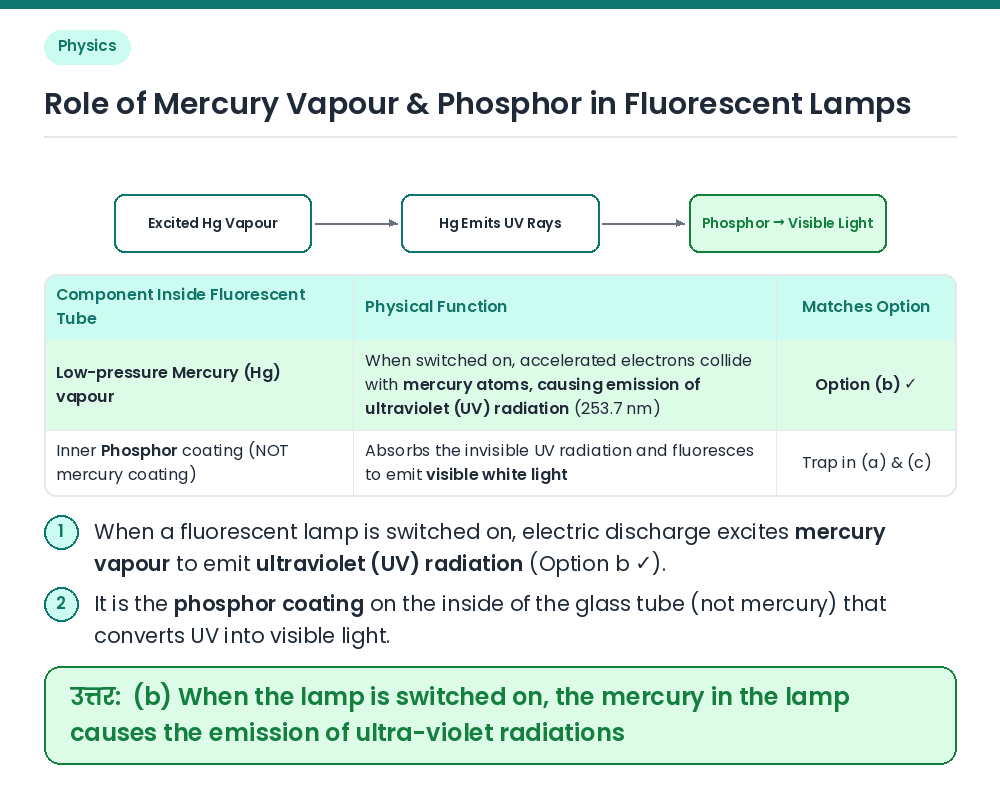
उत्तर: (B) When the lamp is switched on, the mercury in the lamp causes the emission of ultra-violet radiations
Concept: A fluorescent lamp (or CFL) is a low-pressure mercury-vapour gas-discharge lamp filled with argon gas and a tiny amount of mercury. Two-Step Light Emission: Step A — When the lamp is switched on, an electric current passes through the gas, and free electrons collide with mercury vapour atoms, exciting them so that they emit short-wave ultraviolet (UV) radiation (Option b is correct). Step B — The inner glass wall is coated with a fluorescent 'phosphor' powder (not mercury), which absorbs the UV photons and re-emits visible white light (making Options a and c false). Result: Option (b) is correct. Related Facts: • Minamata Convention on Mercury (adopted in 2013, entered into force in 2017; ratified by India in 2018) is a global treaty to protect human health and the environment from anthropogenic mercury emissions. • Solid-state LED (Light Emitting Diode) lamps contain zero mercury and consume ~50% less energy than CFLs. सही उत्तर: (b) When the lamp is switched on, the mercury in the lamp causes the emission of ultra-violet radiations