Civil Services Examination · प्रश्न 38
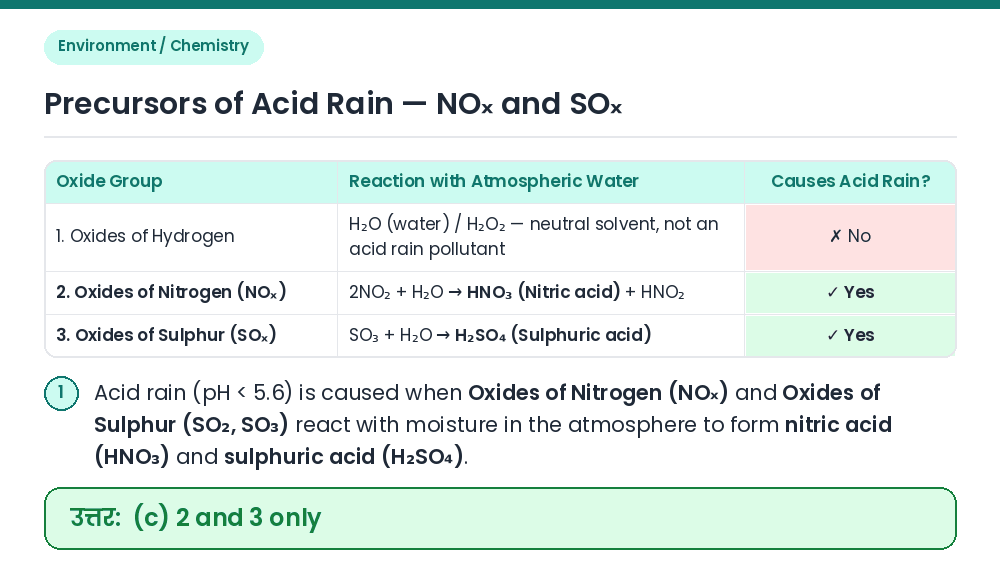
Consider the following: 1. Oxides of Hydrogen 2. Oxides of Nitrogen 3. Oxides of Sulphur Which of the above causes/cause acid rain?
उत्तर देखें और व्याख्याव्याख्या देखें
उत्तर: (C) 2 and 3 only
Concept: Acid rain refers to precipitation (rain, snow, fog) with a pH below 5.6 due to dissolved strong mineral acids. Chemical Reactions: Sulphur dioxide (SO₂) and nitrogen oxides (NOₓ) emitted from fossil fuel combustion oxidize in the atmosphere and react with water vapour to form sulphuric acid (H₂SO₄, ~70% contribution) and nitric acid (HNO₃, ~30% contribution). Eliminate 1: The primary oxide of hydrogen is water (H₂O) itself, which is neutral. Result: Only 2 (Oxides of Nitrogen) and 3 (Oxides of Sulphur) cause acid rain. Related Facts: • Normal unpolluted rainwater is slightly acidic (pH ~5.6) due to dissolved atmospheric CO₂ forming weak carbonic acid (H₂CO₃). • 'Marble cancer' (yellowing and corrosion of the Taj Mahal's calcium carbonate marble) is caused by acid rain from SO₂/NOₓ emissions in the Agra-Mathura region. सही उत्तर: (c) 2 and 3 only