Civil Services Examination · प्रश्न 60
Other than Jatropha curcas, why is Pongamia pinnata also considered a good option for the production of bio-diesel in India? 1. Pongamia pinnata grows naturally in most of the arid regions of India. 2. The seeds of Pongamia pinnata are rich in lipid content of which nearly half is oleic acid. Which of the statements given above is/are correct?
उत्तर देखें और व्याख्याव्याख्या देखें
उत्तर: (C) Both 1 and 2
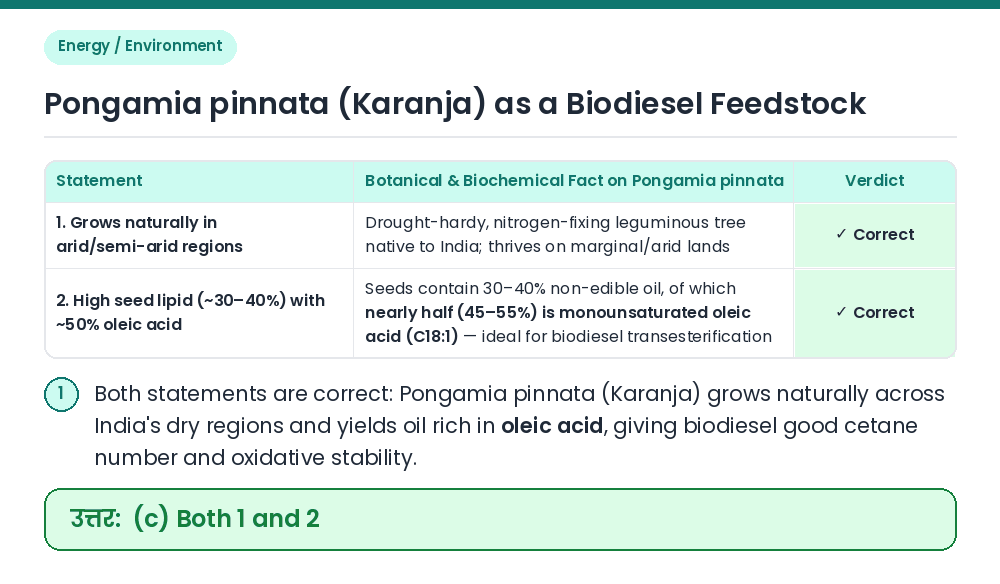
Concept: Pongamia pinnata (syn. Millettia pinnata, commonly called Karanja or Honge) is an indigenous, leguminous, non-edible oilseed tree promoted under India's National Policy on Biofuels. Check Statement 1: Pongamia pinnata is hardy, drought-resistant, salinity-tolerant, and grows naturally across most of the arid and semi-arid regions of India without competing with food crops ⇒ Statement 1 is correct. Check Statement 2: Pongamia seeds contain 30%–40% lipid (oil), and fatty acid profiling shows that 45%–55% (nearly half) of its fatty acids consist of oleic acid (C18:1), which transesterifies into high-quality biodiesel ⇒ Statement 2 is correct. Result: Both 1 and 2 are correct. Related Facts: • Because Pongamia pinnata is a leguminous tree (family Fabaceae), its root nodules fix atmospheric nitrogen and enrich degraded soils. • Biodiesel is produced chemically by reacting vegetable oils or animal fats with an alcohol (methanol) in the presence of a catalyst — a process called transesterification. सही उत्तर: (c) Both 1 and 2