Civil Services Examination · प्रश्न 149
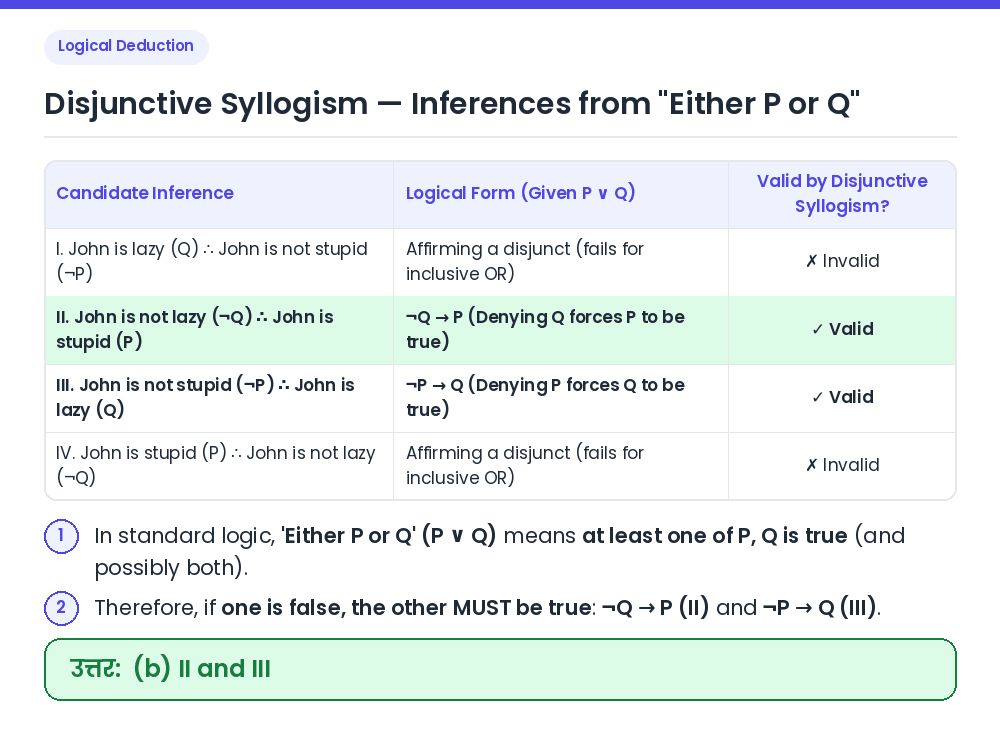
Which of the following can be inferred from the statement that ‘Either John is stupid or John is lazy’? I. John is lazy / therefore, John is not stupid. II. John is not lazy / therefore, John is stupid. III. John is not stupid / therefore, John is lazy. IV. John is stupid / therefore, John is not lazy. Choose the correct answer from the codes given below: Codes:
उत्तर देखें और व्याख्याव्याख्या देखें
उत्तर: (B) II and III
Concept — Inclusive Disjunction: Let P = 'John is stupid' and Q = 'John is lazy'. In logic, the statement 'Either P or Q' (P ∨ Q) guarantees that at least one of the two propositions is true (and does not rule out both being true). Apply Disjunctive Syllogism: If one of the two alternatives is known to be false, the other must necessarily be true: ⇒ If John is not lazy (¬Q), then John must be stupid (P) — Statement II is valid. ⇒ If John is not stupid (¬P), then John must be lazy (Q) — Statement III is valid. Eliminate I and IV: Knowing that John is lazy (I) or that John is stupid (IV) does not prove he lacks the other trait. Result: Statements II and III can be validly inferred. सही उत्तर: (b) II and III