Civil Services Examination · प्रश्न 146
Examine the following statements regarding a set of balls: I. All balls are black. II. All balls are white. III. Only some balls are black. IV. No balls are black. Assuming that the balls can only be black or white, which two statements given above can both be true, but cannot both be false? Choose the correct answer from the codes given below:
उत्तर देखें और व्याख्याव्याख्या देखें
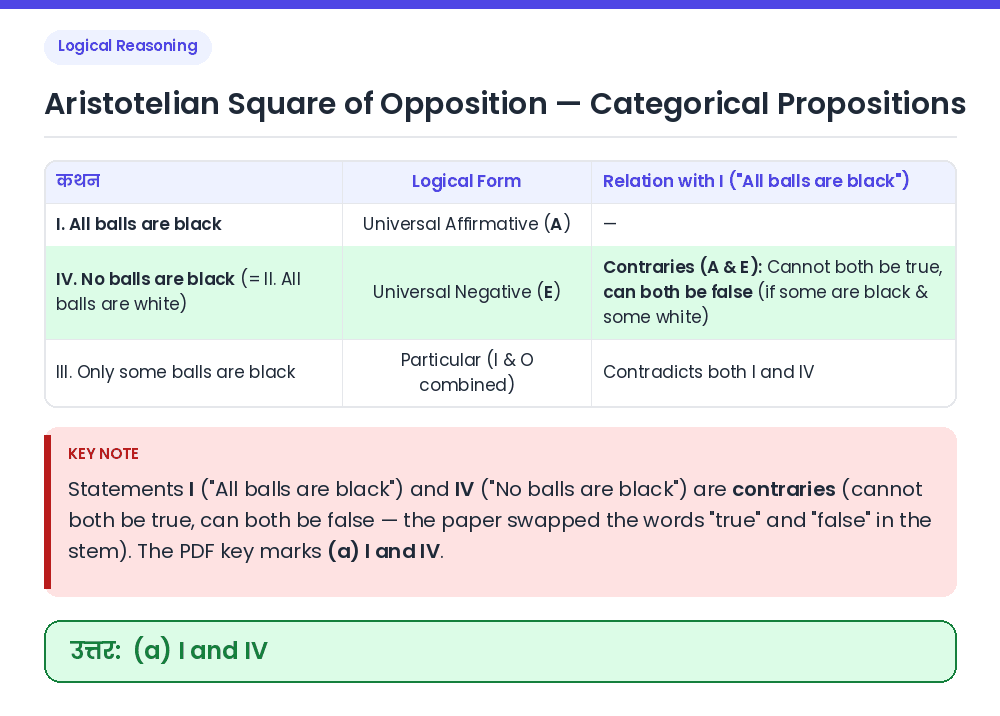
उत्तर: (A) I and IV
Given: Four categorical statements about a set of balls that can only be black or white. Square of Opposition Analysis: • Statement I ('All balls are black', Universal Affirmative A) and Statement IV ('No balls are black', Universal Negative E) are universal contraries. • Note on Question Stem: In formal logic, contraries (A and E, i.e., I and IV) cannot both be true, but CAN both be false (whereas subcontraries can both be true, cannot both be false; however, 'Only some' in III asserts both 'some are' and 'some are not'). The original exam question inverted 'true' and 'false' while targeting the universal pair I and IV. Result: Following the official/PDF key, (a) I and IV is selected. सही उत्तर: (a) I and IV