Civil Services Examination · प्रश्न 28
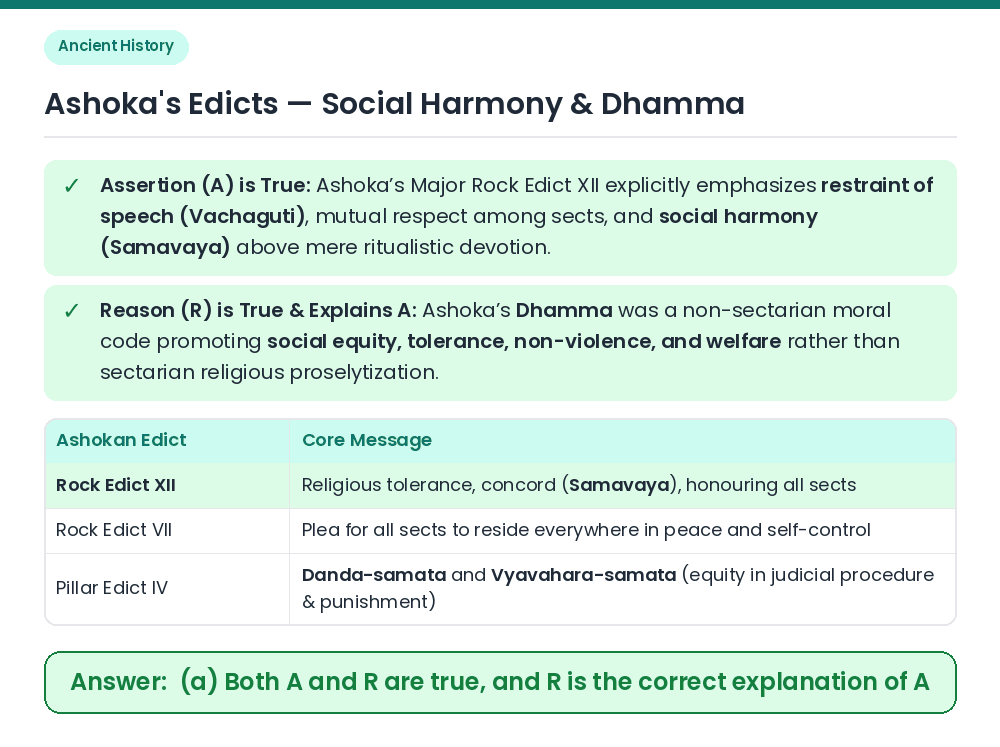
Assertion (A): According to Asoka's edicts social harmony among the people was more important than religious devotion. Reason (R): He spread ideas of equity instead of promotion of religion.
उत्तर देखें और व्याख्याव्याख्या देखें
उत्तर: (A) Both A and R are true, and R is the correct explanation of A
Given / Concept: Emperor Ashoka propounded his policy of 'Dhamma' through Major and Minor Rock Edicts and Pillar Edicts across the Mauryan Empire. Evaluate Assertion A: In Major Rock Edict XII and Rock Edict XI, Ashoka stated that social concord (Samavaya), ethical conduct, and respect for other sects were far more valuable than lavish religious rituals or sectarian devotion ⇒ A is true. Evaluate Reason R & Link: Rather than imposing sectarian Buddhism as a state religion, Ashoka promoted universal moral equity, social ethics, humane treatment of servants, and judicial fairness (Vyavahara-samata) ⇒ R is true and directly explains A. Result: Both A and R are true, and R is the correct explanation of A. Related Facts: • Dhamma Mahamattas: Special officers appointed by Ashoka in his 13th regnal year (Rock Edict V) to propagate Dhamma and look after the welfare of all sects. • Decipherment of Edicts: James Prinsep deciphered the Brahmi script of Ashoka's edicts in 1837. Correct Answer: (a) Both A and R are true, and R is the correct explanation of A