Civil Services Examination · प्रश्न 31
Assertion (A): The first ever Bill to make primary education compulsory in India was rejected in 1911. Reason (R): Discontent would have increased if every cultivator could read.
उत्तर देखें और व्याख्याव्याख्या देखें
उत्तर: (A) Both A and R are true, and R is the correct explanation of A
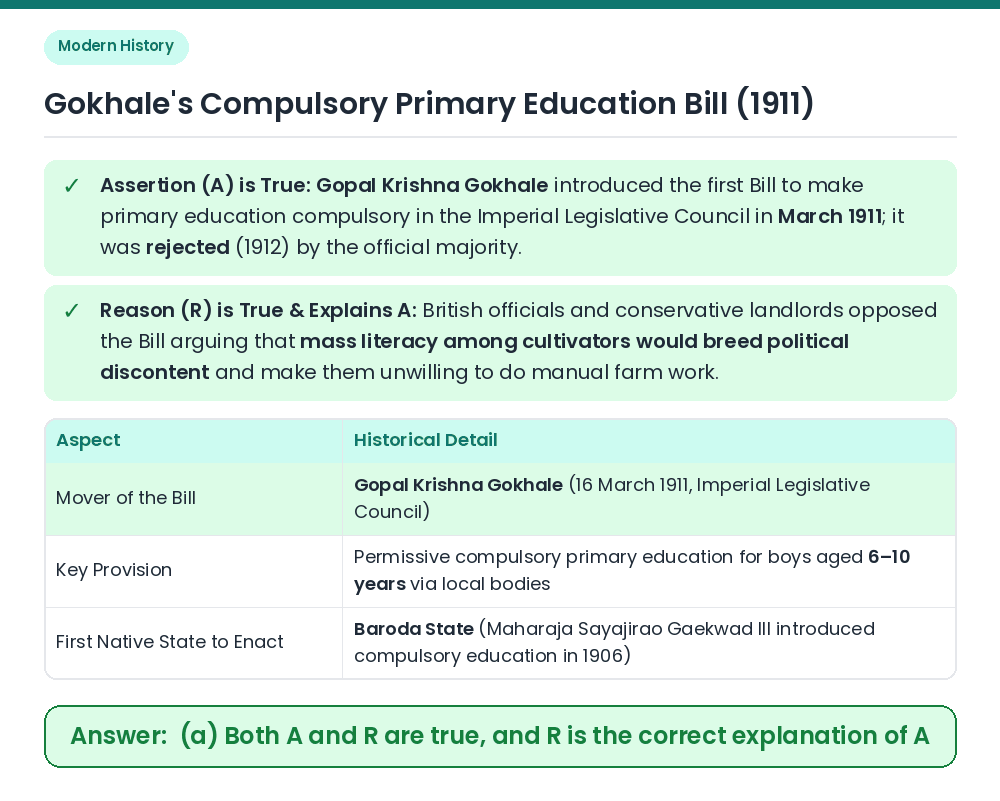
Given / Concept: In March 1911, nationalist leader Gopal Krishna Gokhale introduced a private member's Bill in the Imperial Legislative Council to introduce free and compulsory primary education in British India. Evaluate Assertion A: The colonial government and its official majority opposed and defeated Gokhale's Elementary Education Bill ⇒ A is true. Evaluate Reason R & Link: During the Council debates, colonial officials and landed elites argued that educating every cultivator would create political unrest/discontent against colonial authority and agrarian hierarchy ⇒ R is true and explains why the Bill was rejected. Result: Both A and R are true, and R is the correct explanation of A. Related Facts: • Baroda Precedent (1906): Maharaja Sayajirao Gaekwad III had already introduced free and compulsory primary education across the princely state of Baroda in 1906. • Right to Education (Article 21A): Added to the Indian Constitution by the 86th Amendment Act, 2002, making education a Fundamental Right for children aged 6–14 years. Correct Answer: (a) Both A and R are true, and R is the correct explanation of A