Civil Services Examination · प्रश्न 50
The farmers are provided credit from a number of sources for their short and long-term needs. The main sources of credit to the farmers include
उत्तर देखें और व्याख्याव्याख्या देखें
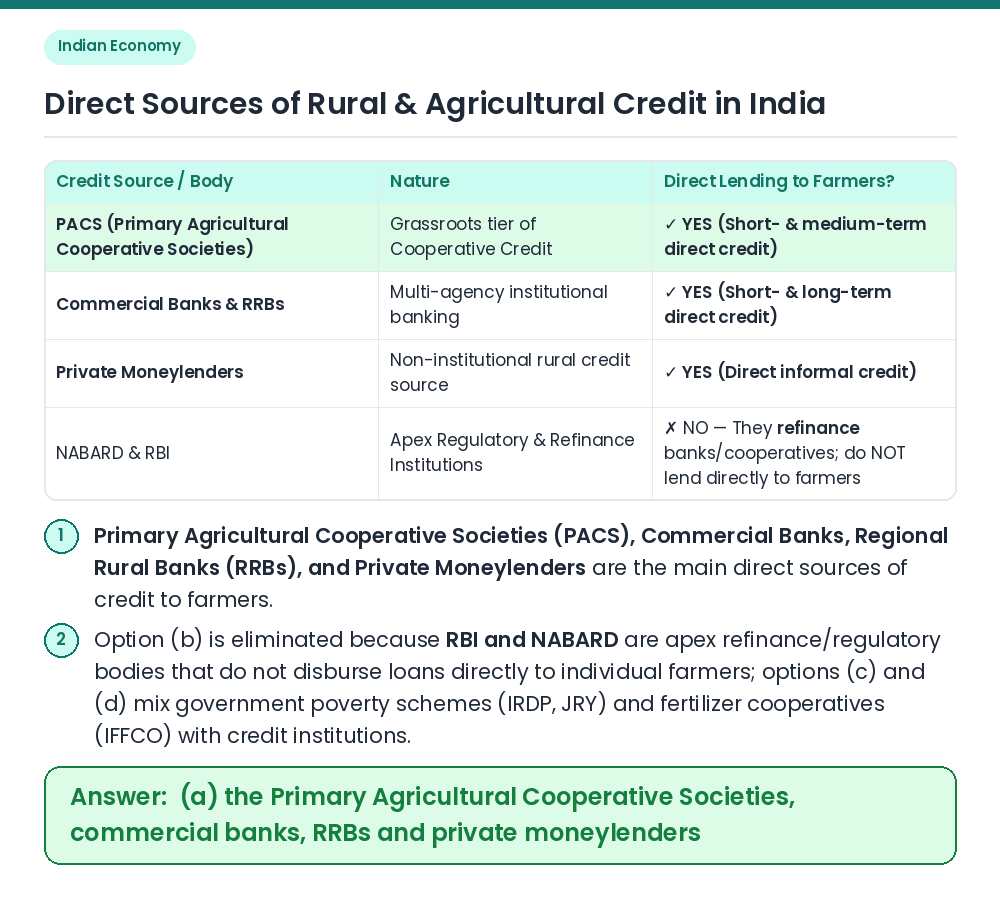
उत्तर: (A) the Primary Agricultural Cooperative Societies, commercial banks, RRBs and private moneylenders
Concept: Agricultural credit in India is delivered directly to farmers through institutional agencies (Cooperatives, Commercial Banks, RRBs) and non-institutional sources (moneylenders, traders). Eliminate Option b: NABARD and RBI are apex refinancing and regulatory bodies — they provide refinance to banks and cooperatives but do not deal directly with individual farmers. Eliminate Options c & d: IRDP and JRY (in c) are government poverty/employment programmes rather than credit institutions, and IFFCO (in d) is a fertilizer manufacturing cooperative. Result: The main direct sources of credit to farmers are Primary Agricultural Cooperative Societies (PACS), commercial banks, RRBs, and private moneylenders. Related Facts: • NABARD (12 July 1982): Established on the recommendation of the B. Sivaraman Committee (CRAFICARD) as the apex institution for rural credit refinance. • Regional Rural Banks (1975): Established on 2 October 1975 based on the M. Narasimham Working Group recommendations. Correct Answer: (a) the Primary Agricultural Cooperative Societies, commercial banks, RRBs and private moneylenders