UP Super TET · Question 132
The instinct theory of motivation was given by
Show answer & explanationShow explanation
Answer: (C) McDougall
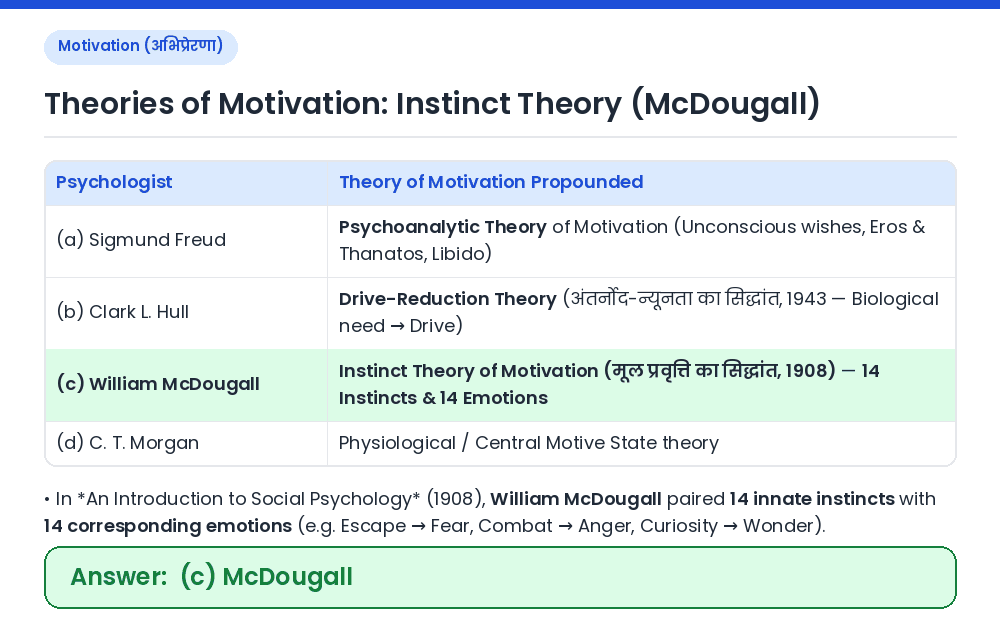
The Instinct Theory of Motivation (अभिप्रेरणा का मूल प्रवृत्ति सिद्धान्त) was propounded by British-American psychologist William McDougall in 1908. • In his work 'An Introduction to Social Psychology' (1908), McDougall argued that all human and animal behaviour is energized and directed by innate, unlearned biological instincts (मूल प्रवृत्तियाँ). • McDougall listed 14 primary instincts, each associated with a specific corresponding emotion (संवेग)—for example, Escape with Fear (पलायन–भय), Combat with Anger (युयुत्सा–क्रोध), Repulsion with Disgust (निवृत्ति–घृणा), and Parental instinct with Tender emotion/Love (संतान कामना–वात्सल्य). Why other options are wrong: • (a) Sigmund Freud: Propounded the Psychoanalytic Theory of Motivation based on unconscious instincts (life instinct Eros and death instinct Thanatos). • (b) Clark L. Hull: Propounded the Drive-Reduction Theory (अंतर्नोद-न्यूनता सिद्धांत, 1943) based on homeostasis. • (d) C. T. Morgan: Known for physiological motivation research ('Central Motive State'). Related Facts: • Other major theories of motivation: Hierarchy of Needs Theory — Abraham Maslow (1943/1954); Achievement Motivation Theory — David McClelland; Two-Factor (Hygiene-Motivator) Theory — Frederick Herzberg; Expectancy Theory — Victor Vroom. • B. F. Skinner called motivation the 'National Highway (Superhighway) to Learning'. Correct Answer: (c) McDougall