UP Super TET · Question 149
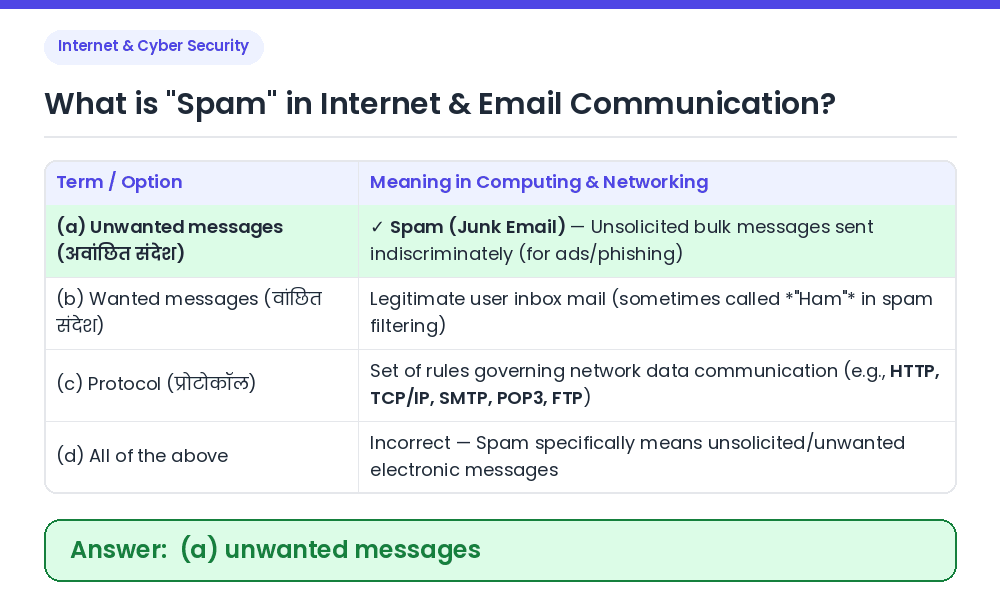
Spam is
Show answer & explanationShow explanation
Answer: (A) unwanted messages
In computing and internet communication, 'Spam' refers to unwanted, unsolicited electronic messages (especially bulk junk emails) sent indiscriminately to a large number of recipients. • Most spam messages are commercial advertisements, promotional clutter, or malicious phishing links sent without the recipient's consent. • Email services use automated 'Spam filters' to divert such unsolicited messages into a separate Spam or Junk folder. Why other options are wrong: • (b) wanted messages: Desired, legitimate emails are the opposite of spam (often called 'Ham' in machine-learning spam classifiers). • (c) protocol: A network protocol is a set of rules for data transmission (e.g., SMTP for sending email, POP3/IMAP for receiving email, HTTP for the web). • (d) All of the above: Invalid since only option (a) defines spam. Related Facts: • The first known email spam was sent on 3 May 1978 by Gary Thuerk to ~400 ARPANET users advertising DEC computers. • Email protocols: SMTP (Simple Mail Transfer Protocol — used for sending emails); POP3 (Post Office Protocol v3) and IMAP (Internet Message Access Protocol) — used for retrieving emails. Correct Answer: (a) unwanted messages