UP Super TET · Question 73
The nature of sound waves is
Show answer & explanationShow explanation
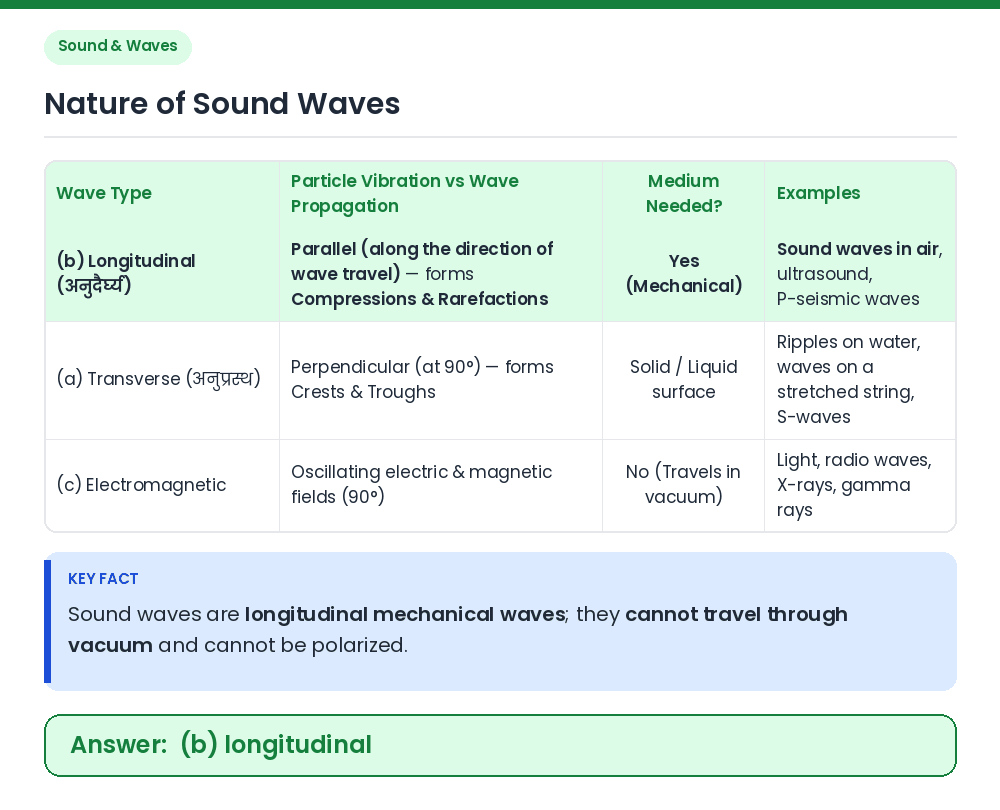
Answer: (B) longitudinal
Sound waves in air and fluids are longitudinal mechanical waves in nature. • In a longitudinal wave, the particles of the medium oscillate back and forth parallel to the direction of wave propagation, creating alternating regions of high pressure (Compressions) and low pressure (Rarefactions). • Because sound waves require a material medium (solid, liquid, or gas) to propagate, they cannot travel through a vacuum. Why other options are wrong: • (a) transverse: In transverse waves, particles vibrate perpendicular (at 90°) to wave propagation, forming crests and troughs; because longitudinal sound waves vibrate parallel to propagation, sound cannot be polarized. • (c) electromagnetic: Electromagnetic waves (like light and radio waves) do not require a medium and travel through vacuum at 3 × 10⁸ m/s. • (d) None of the above: Invalid since option (b) is correct. Related Facts: • Speed of sound is maximum in solids, less in liquids, and minimum in gases (v_solid > v_liquid > v_gas); in dry air at 20 °C it is ~343 m/s (at 0 °C it is ~331 m/s). • Audible frequency range for humans: 20 Hz to 20,000 Hz (20 kHz); < 20 Hz is Infrasonic, > 20 kHz is Ultrasonic. • Unlike light waves, sound waves do not exhibit polarization (ध्रुवण) because they are longitudinal. Correct Answer: (b) longitudinal