UP Super TET · Question 82
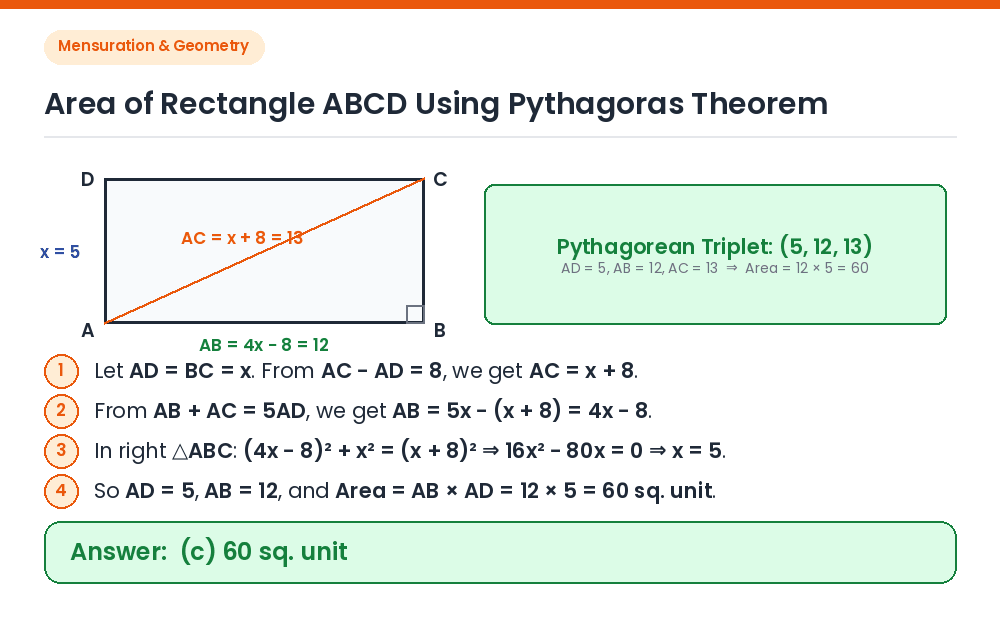
In the adjoining figure, if AB + AC = 5AD and AC − AD = 8, then the area of the rectangle ABCD is

Show answer & explanationShow explanation
Answer: (C) 60 sq. unit
Given: In rectangle ABCD, AB + AC = 5AD and AC − AD = 8. Formula: In right-angled △ABC, AC² = AB² + BC² (where BC = AD), and Area of rectangle = AB × AD. Express AC and AB in terms of AD = x: Let AD = BC = x. Then AC − x = 8 ⇒ AC = x + 8, and AB = 5x − AC = 5x − (x + 8) ⇒ AB = 4x − 8. Apply Pythagoras theorem in right △ABC: AB² + BC² = AC² ⇒ (4x − 8)² + x² = (x + 8)². Solve for x: 16x² − 64x + 64 + x² = x² + 16x + 64 ⇒ 16x² − 80x = 0 ⇒ 16x(x − 5) = 0 ⇒ x = 5 (since x > 0). Calculate sides and area: AD = 5 units and AB = 4(5) − 8 = 12 units ⇒ Area = AB × AD = 12 × 5 = 60 sq. unit. Result: The area of rectangle ABCD is 60 sq. unit. Shortcut: Spot the standard Pythagorean triplet with AC − AD = 8: the (5, 12, 13) right triangle has 13 − 5 = 8 and 12 + 13 = 25 = 5 × 5 ⇒ Area = 12 × 5 = 60 sq. unit. Common mistake: Taking ½ × 12 × 5 = 30 (area of △ABC instead of full rectangle ABCD). Correct Answer: (c) 60 sq. unit