UP Super TET · Question 113
sin⁻¹(5/13) + cos⁻¹(3/5) is equal to which of the following?
Show answer & explanationShow explanation
Answer: (B) tan⁻¹(63/16)
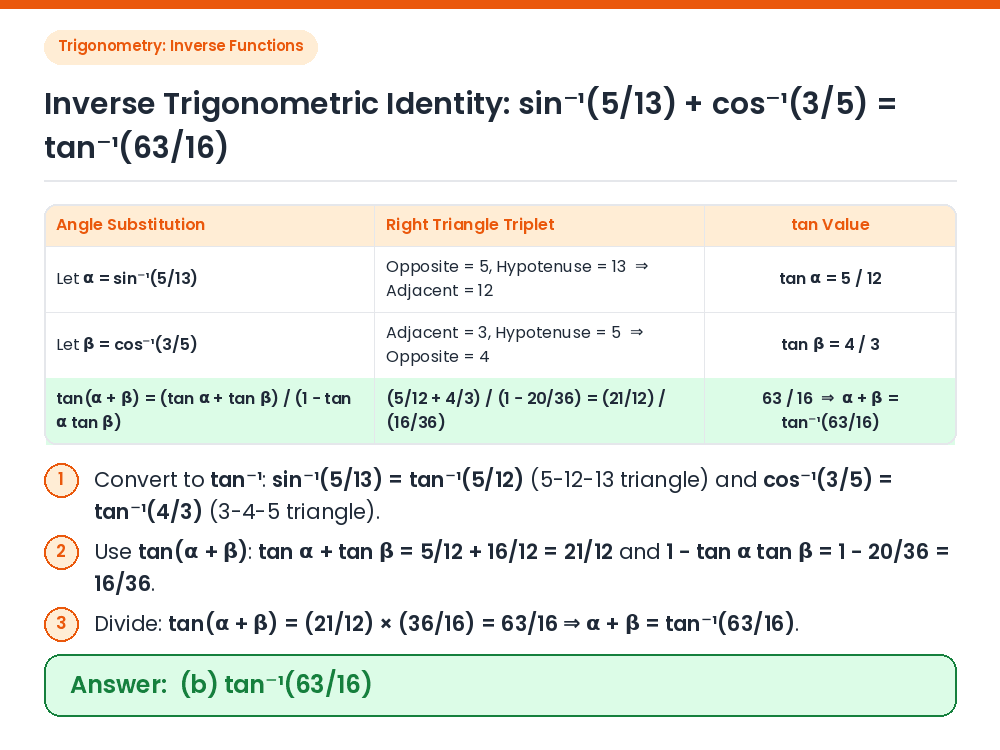
Given: Expression E = sin⁻¹(5/13) + cos⁻¹(3/5). Formula: Convert both inverse trigonometric terms into tan⁻¹ using right-triangle triplets, and apply tan(α + β) = (tan α + tan β) / (1 − tan α·tan β). Convert each term to tan: Let α = sin⁻¹(5/13); from the (5, 12, 13) Pythagorean triplet, cos α = 12/13 and tan α = 5/12. Let β = cos⁻¹(3/5); from the (3, 4, 5) Pythagorean triplet, sin β = 4/5 and tan β = 4/3. Step 2 (Compute tan(α + β)): tan(α + β) = (5/12 + 4/3) / [1 − (5/12)(4/3)] = (21/12) / (16/36) = (21/12) × (36/16) ⇒ 63/16. Verify quadrant and inverse: Since sin α = 5/13 < 1/√2 and cos β = 3/5 < 1/√2, α + β is an acute angle in (0, π/2) with tan(α + β) = 63/16 ⇒ α + β = tan⁻¹(63/16). Result: sin⁻¹(5/13) + cos⁻¹(3/5) = tan⁻¹(63/16). Shortcut: Since 63/16 > 1, sin⁻¹(63/16) and cos⁻¹(63/16) are not even defined for real angles (as |sin θ| ≤ 1 and |cos θ| ≤ 1), immediately eliminating (a) and (c)! Common mistake: Confusing sin(α + β) = 63/65 with sin⁻¹(63/16). Correct Answer: (b) tan⁻¹(63/16)