UP Super TET · Question 58
In which of the following process oxygen is not required?
Show answer & explanationShow explanation
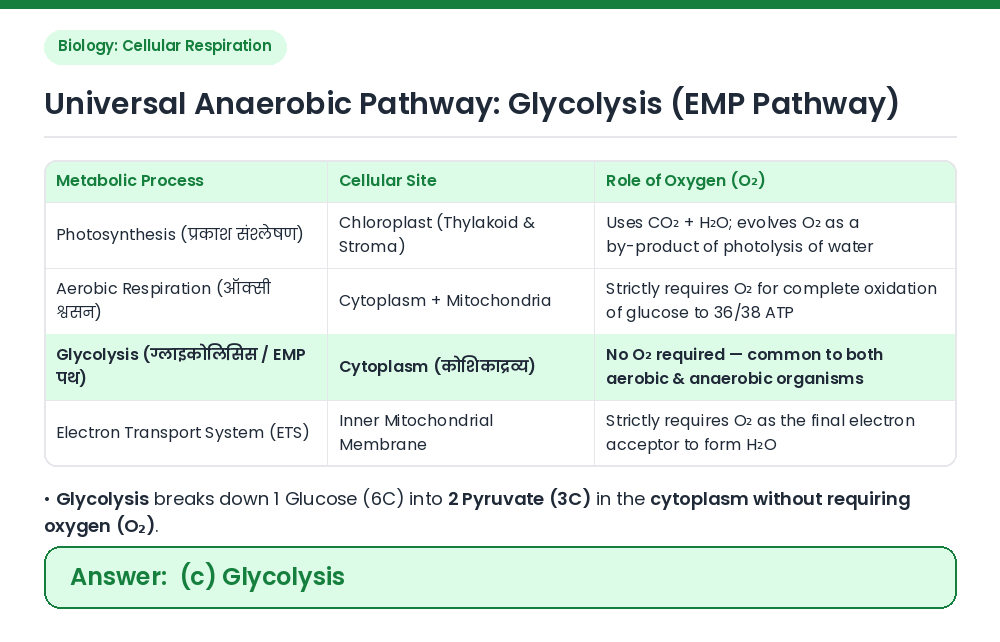
Answer: (C) Glycolysis
In cellular respiration, oxygen is not required in Glycolysis (also known as the EMP pathway). Glycolysis takes place in the cytoplasm of all living cells (both prokaryotic and eukaryotic) and converts one 6-carbon glucose molecule into two 3-carbon pyruvic acid molecules with a net gain of 2 ATP and 2 NADH without using molecular oxygen (O₂). (Note: Photosynthesis also does not consume O₂ as a reactant—it consumes CO₂ and H₂O and releases O₂—so both (a) and (c) do not require O₂; in the context of respiratory pathways alongside options b and d, Glycolysis is the standard textbook answer.) Why other options are wrong: • (a) Photosynthesis: Anabolic process using CO₂ + H₂O in sunlight to release O₂ (accepted as an alternative key in some biology contexts, while PNP respiratory context keys Glycolysis). • (b) Aerobic respiration: Requires O₂ for complete oxidation of pyruvate in mitochondria. • (d) Electron transport system (ETS): Requires O₂ at Complex IV as the terminal electron acceptor. Related Facts: • Glycolysis was discovered by Gustav Embden, Otto Meyerhof, and Jakub Parnas (hence called the EMP Pathway). • Gross ATP produced in glycolysis is 4 ATP, while 2 ATP are consumed in the preparatory phase, leaving a net gain of 2 ATP. Correct Answer: (c) Glycolysis