UP Super TET · Question 82
Amoeba is a
Show answer & explanationShow explanation
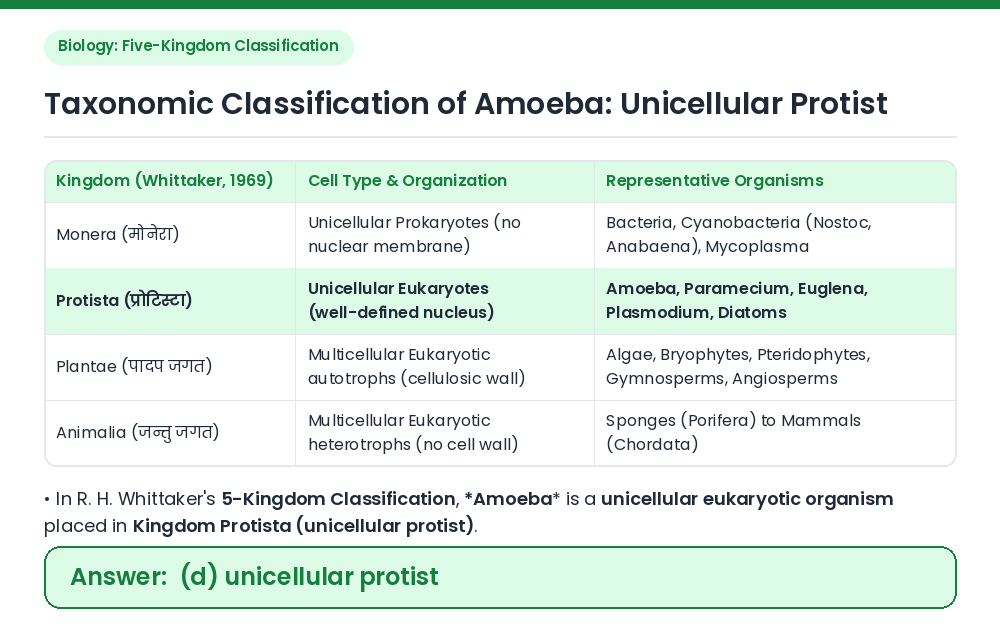
Answer: (D) unicellular protist
According to modern biological classification (R. H. Whittaker's Five-Kingdom System, 1969), Amoeba is a unicellular protist (Kingdom Protista, group Protozoa/Sarcodina). Kingdom Protista encompasses all unicellular eukaryotic organisms having a membrane-bound nucleus and organelles, whereas Kingdom Animalia includes only multicellular eukaryotic consumers (Metazoa). (Note: In traditional 2-kingdom zoology, Amoeba was also described as a unicellular protozoan animal; in modern NCERT taxonomy, 'unicellular protist' is the precise designation.) Why other options are wrong: • (a) unicellular animal: Under the modern 5-kingdom system, all true animals (Kingdom Animalia) are multicellular, while unicellular protozoans are placed in Kingdom Protista. • (b) bacterium: Bacteria are prokaryotic organisms placed in Kingdom Monera. • (c) unicellular plant: Amoeba lacks chlorophyll and a cell wall and shows holozoic nutrition. Related Facts: • Amoeba moves and captures food (phagocytosis) by means of false feet called pseudopodia (lobopodia). • Osmoregulation in freshwater Amoeba proteus is performed by the contractile vacuole. Correct Answer: (d) unicellular protist