UP Super TET · Question 95
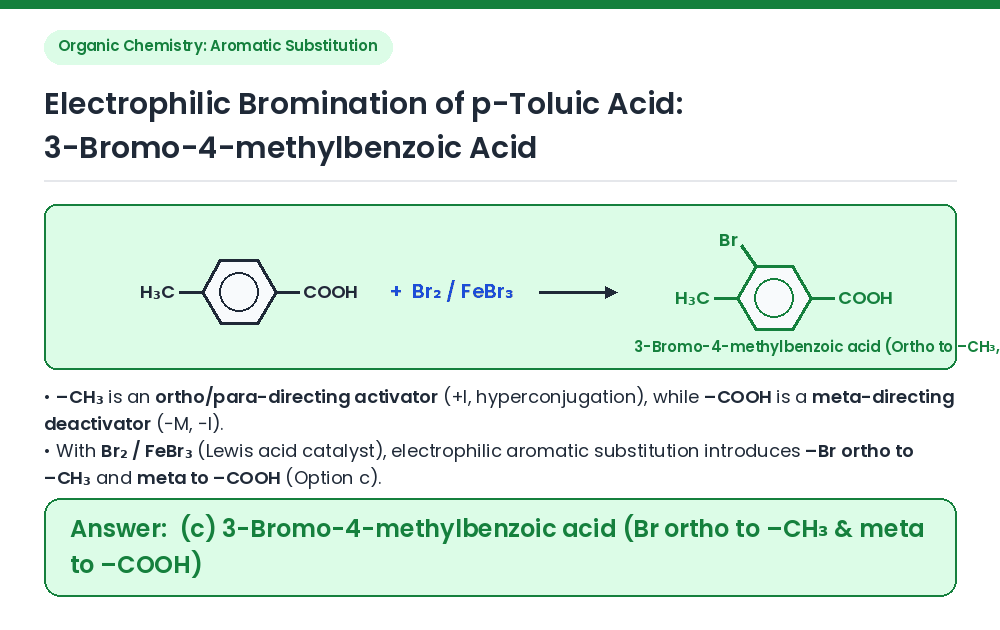
The product ‘X’ in the following reaction is (p-CH₃–C₆H₄–COOH + Br₂ / FeBr₃ → ‘X’)

Show answer & explanationShow explanation
Answer: (C) 3-Bromo-4-methylbenzoic acid (Br ortho to –CH₃ and meta to –COOH)
In the reaction of 4-methylbenzoic acid (p-toluic acid) with Br₂ in the presence of Lewis acid catalyst FeBr₃, the major product 'X' is 3-bromo-4-methylbenzoic acid — Option (c), where –Br is attached to the benzene ring ortho to –CH₃ and meta to –COOH. Reaction mechanism & directing effect: Br₂ / FeBr₃ generates the bromonium electrophile (Br⁺) for electrophilic aromatic substitution on the benzene ring. In p-toluic acid, the methyl group (–CH₃) is an activating ortho/para-director (since its para position C1 is already blocked by –COOH, it directs Br⁺ to its ortho position C3), and the carboxyl group (–COOH) is a deactivating meta-director (which also directs Br⁺ to its meta position C3). Thus both groups reinforce substitution at C3. Why other options are wrong: • (a) (CH₂Br)–C₆H₄–COOH: Side-chain free-radical bromination occurs only with Br₂ / hν (UV light) or heat, not with FeBr₃ in the dark. • (b) 2-Bromo-4-methylbenzoic acid: Places –Br ortho to the deactivating –COOH and meta to activating –CH₃, which is electronically disfavoured. • (d) (CHBr₂)–C₆H₄–COOH: Gem-dibromination of the methyl side chain requires excess Br₂ / hν. Related Facts: • In disubstituted benzenes with one activating group (like –OH, –NH₂, –OCH₃, –CH₃) and one deactivating group (like –NO₂, –COOH, –CHO), the activating group always dominates the orientation of incoming electrophiles. Correct Answer: (c) 3-Bromo-4-methylbenzoic acid (Br ortho to –CH₃ and meta to –COOH)