RRB NTPC · Question 96
In this question, a question is followed by two statements numbered (I) and (II). You have to decide whether the data provided in the statements are sufficient to answer the question. Read both the statements and decide the appropriate answer. Q. Five friends – Gaurav, Himanshu, Ishan, Lokesh, and Mukul – are of different ages. Who is the third oldest? (I) Ishan is older than Gaurav but younger than Lokesh. (II) Mukul is older than Ishan but younger than Lokesh.
Show answer & explanationShow explanation
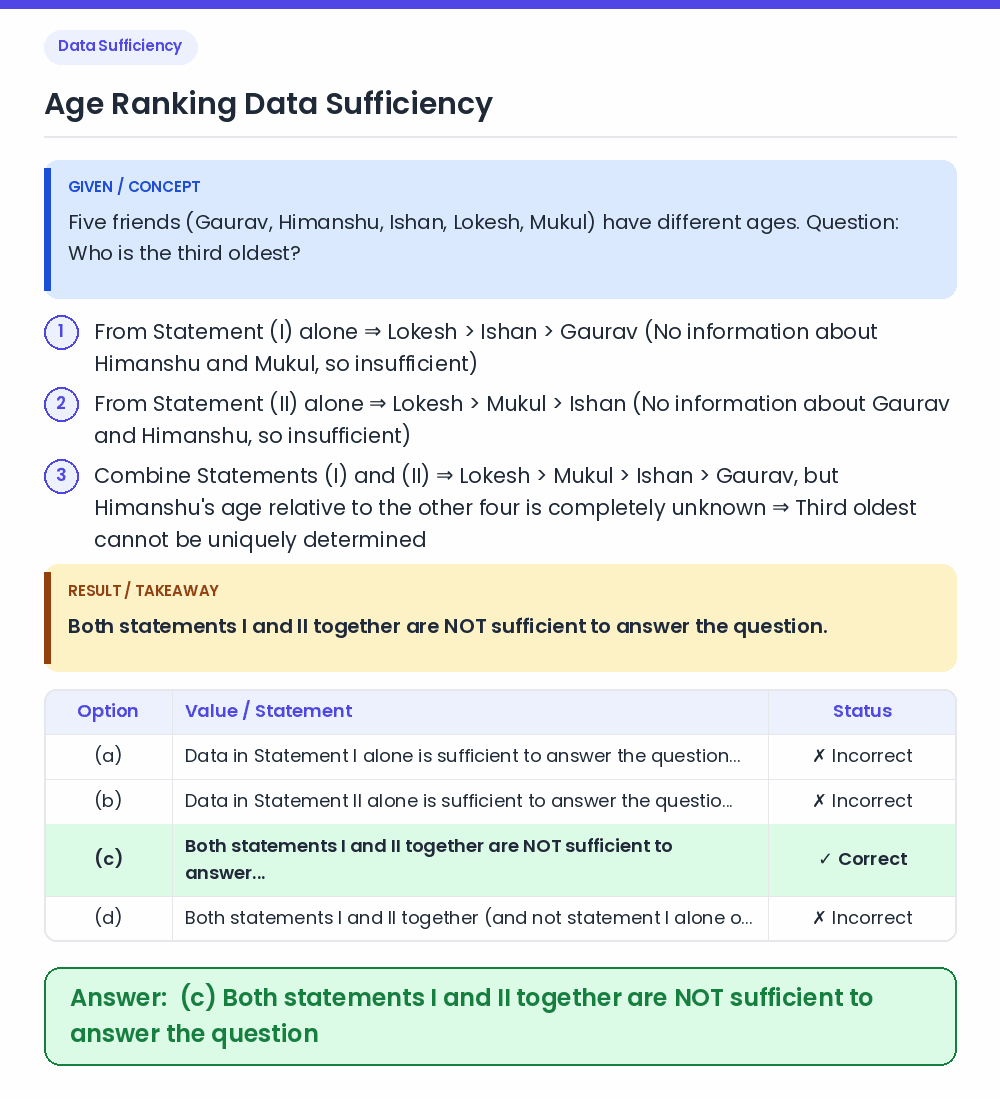
Answer: (C) Both statements I and II together are NOT sufficient to answer the question
GIVEN / CONCEPT: Five friends (Gaurav, Himanshu, Ishan, Lokesh, Mukul) have different ages. Question: Who is the third oldest? Step 1 (Relation / Equation): From Statement (I) alone ⇒ Lokesh > Ishan > Gaurav (No information about Himanshu and Mukul, so insufficient) Step 2 (Simplification / Calculation): From Statement (II) alone ⇒ Lokesh > Mukul > Ishan (No information about Gaurav and Himanshu, so insufficient) Step 3 (Verification / Deduction): Combine Statements (I) and (II) ⇒ Lokesh > Mukul > Ishan > Gaurav, but Himanshu's age relative to the other four is completely unknown ⇒ Third oldest cannot be uniquely determined RESULT / TAKEAWAY: Both statements I and II together are NOT sufficient to answer the question. Correct Answer: (c) Both statements I and II together are NOT sufficient to answer the question