RRB NTPC · Question 38
In this question, a question is followed by two statements numbered (I) and (II). You have to decide whether the data provided in the statements is sufficient to answer the question. Read both the statements and decide the appropriate answer. A, B, C, D, E and F are sitting around a circular table, facing the centre. Who sits to the immediate right of C? (I) D sits to the immediate left of F. C is the immediate neighbour of A and E. (II) B sits second to the left of F. C sits second to the right of F.
Show answer & explanationShow explanation
Answer: (D) Both statements I and II together are not sufficient to answer the question.
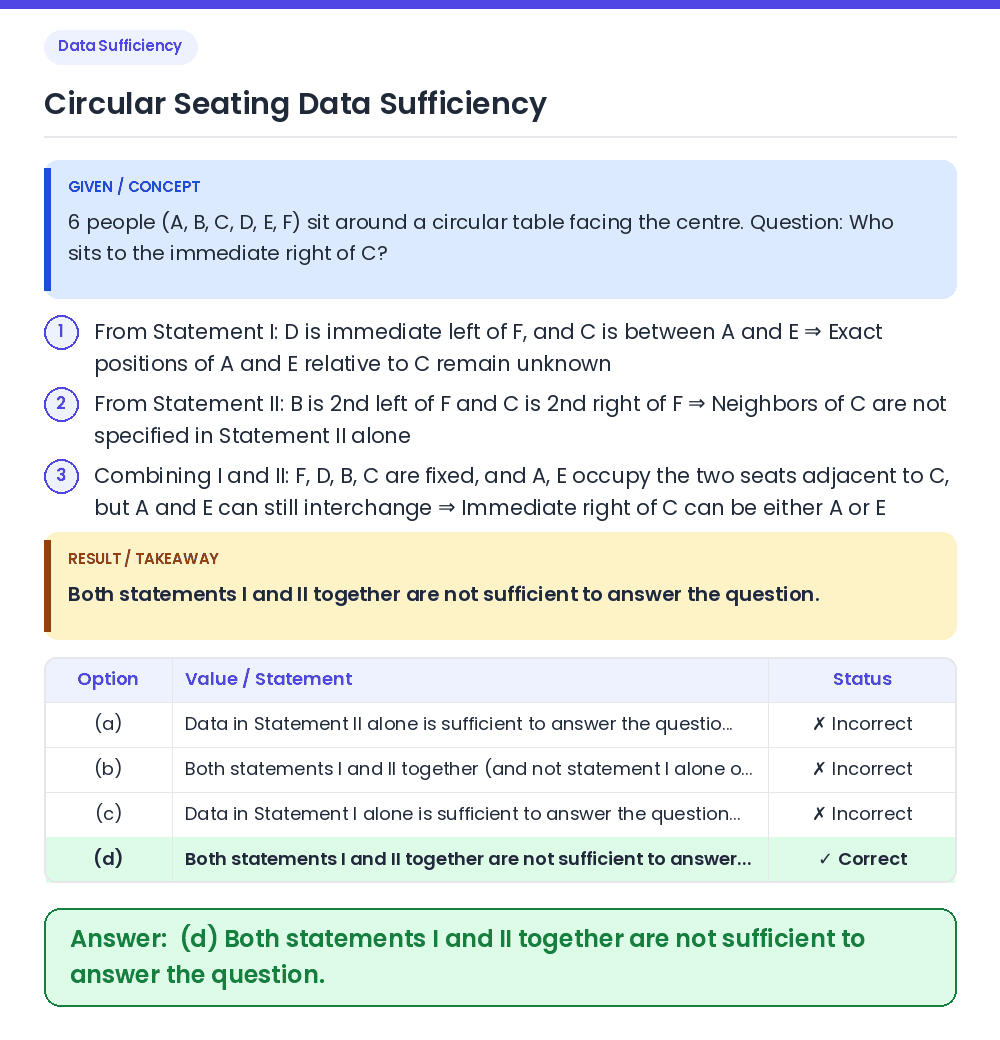
GIVEN / CONCEPT: 6 people (A, B, C, D, E, F) sit around a circular table facing the centre. Question: Who sits to the immediate right of C? From Statement I: D is immediate left of F, and C is between A and E ⇒ Exact positions of A and E relative to C remain unknown From Statement II: B is 2nd left of F and C is 2nd right of F ⇒ Neighbors of C are not specified in Statement II alone Combining I and II: F, D, B, C are fixed, and A, E occupy the two seats adjacent to C, but A and E can still interchange ⇒ Immediate right of C can be either A or E RESULT / TAKEAWAY: Both statements I and II together are not sufficient to answer the question. Correct Answer: (d) Both statements I and II together are not sufficient to answer the question.