RRB NTPC · Question 78
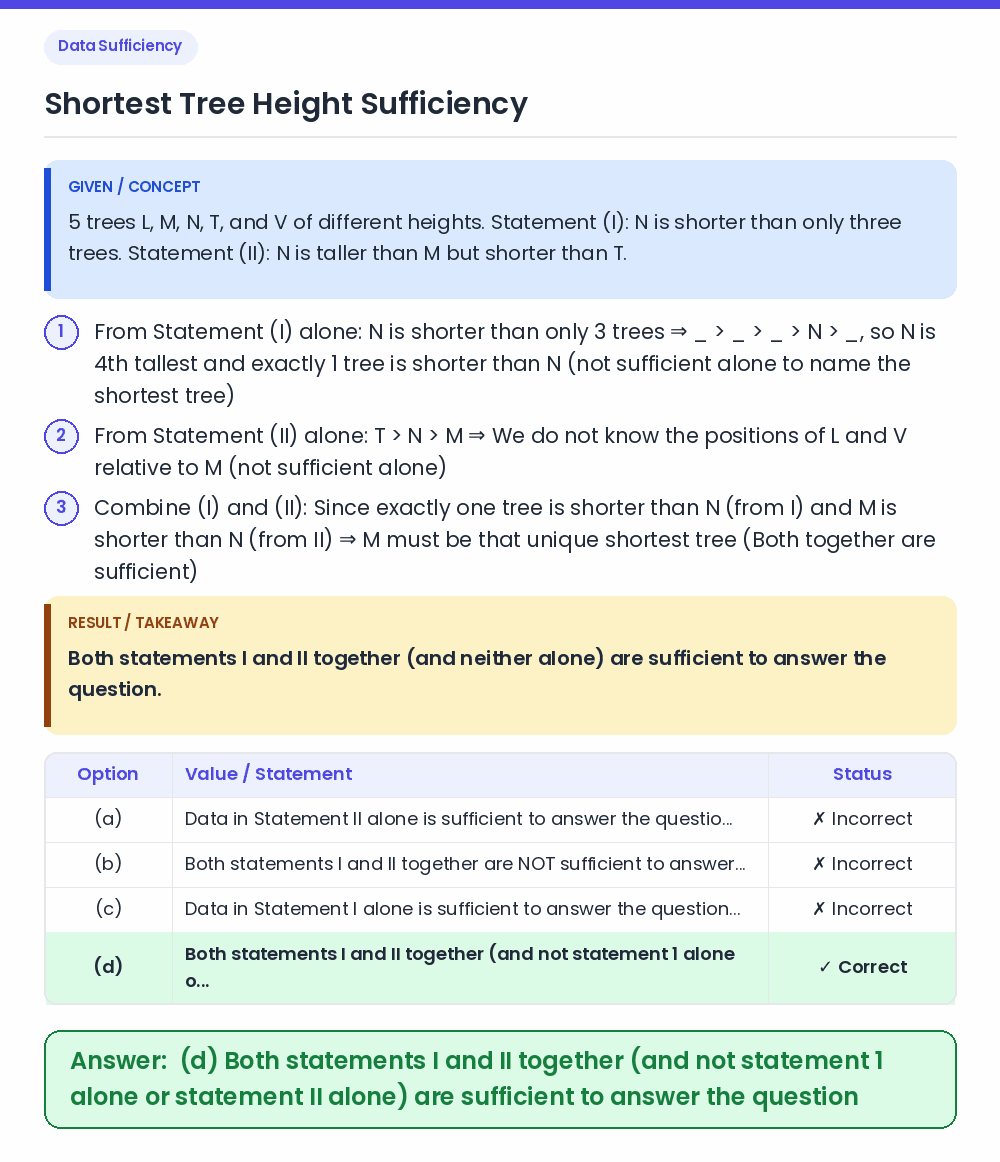
In this question, a question is followed by two statements numbered (I) and (II). You have to decide whether the data provided in the statements are sufficient to answer the question. Read both the statements and decide the appropriate answer. Question: Among 5 trees, L, M, N, T and V each having a different height, which tree is the shortest? Statements: (I) N is shorter than only three trees. (II) N is taller than M but shorter than T.
Show answer & explanationShow explanation
Answer: (D) Both statements I and II together (and not statement 1 alone or statement II alone) are sufficient to answer the question
GIVEN / CONCEPT: 5 trees L, M, N, T, and V of different heights. Statement (I): N is shorter than only three trees. Statement (II): N is taller than M but shorter than T. Step 1 (Relation / Equation): From Statement (I) alone: N is shorter than only 3 trees ⇒ _ > _ > _ > N > _, so N is 4th tallest and exactly 1 tree is shorter than N (not sufficient alone to name the shortest tree) Step 2 (Simplification / Calculation): From Statement (II) alone: T > N > M ⇒ We do not know the positions of L and V relative to M (not sufficient alone) Step 3 (Verification / Deduction): Combine (I) and (II): Since exactly one tree is shorter than N (from I) and M is shorter than N (from II) ⇒ M must be that unique shortest tree (Both together are sufficient) RESULT / TAKEAWAY: Both statements I and II together (and neither alone) are sufficient to answer the question. Correct Answer: (d) Both statements I and II together (and not statement 1 alone or statement II alone) are sufficient to answer the question